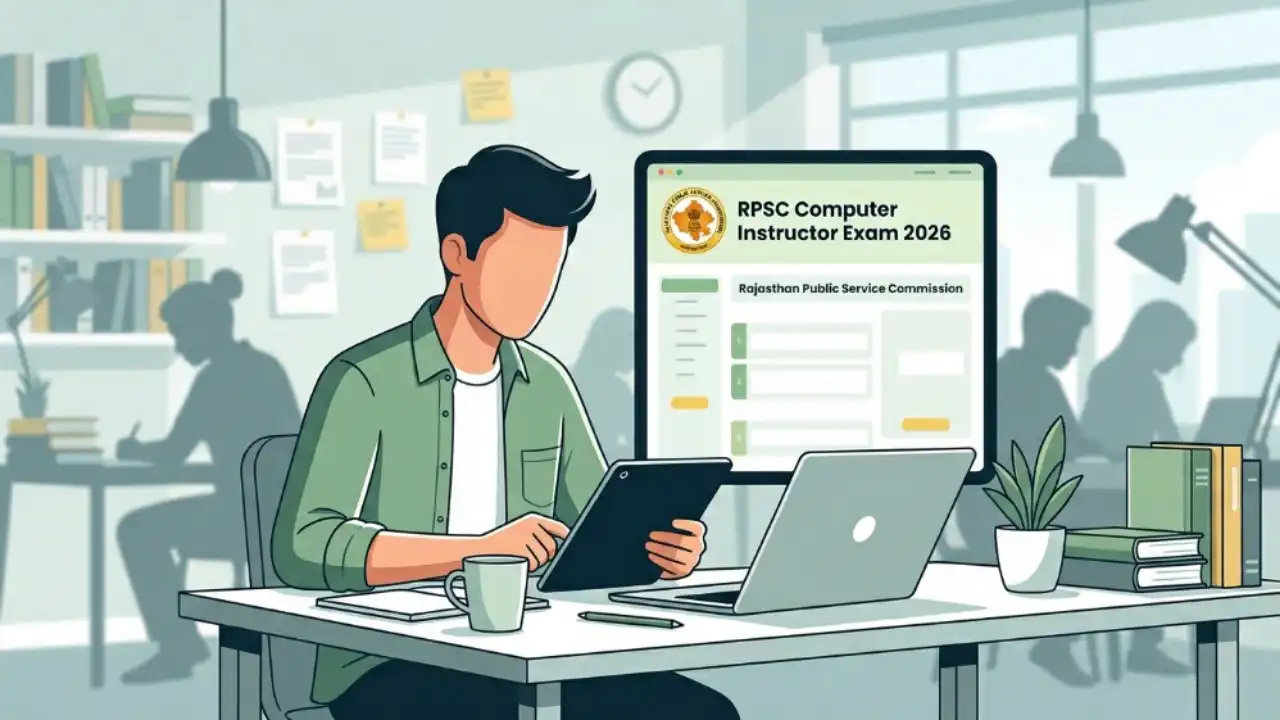
The Rajasthan Computer Instructor recruitment syllabus and exam pattern have been detailed in the official notification issued by the Rajasthan Staff Selection Board for Senior Computer Instructor and Basic Computer Instructor posts. Although many candidates search it as “RPSC Computer Instructor Syllabus,” the recruitment document is from RSSB/Rajasthan Staff Selection Board, not RPSC.
As per the notification, the recruitment drive covers 3,951 posts in total, including 322 Senior Computer Instructor posts and 3,629 Basic Computer Instructor posts across the Secondary Education Department and Sanskrit Education Department. The written examination pattern is broadly similar for both posts, with two papers carrying 100 marks each.
Table of Contents
RSSB Computer Instructor Exam Pattern 2026
The Computer Instructor written examination will carry 200 marks in total. There will be two papers: Paper-I and Paper-II. Each paper will be of 100 marks, will contain 100 multiple-choice questions, and the duration of each paper will be 2 hours.
The board has also confirmed negative marking. For every wrong answer, one-third of the marks prescribed for that question will be deducted. The minimum qualifying marks are 40%, while SC and ST candidates will get a relaxation of 5% in the qualifying marks.
| Paper | Marks | Questions | Duration | Nature |
|---|---|---|---|---|
| Paper-I | 100 | 100 MCQs | 2 hours | Rajasthan GK and General Ability |
| Paper-II | 100 | 100 MCQs | 2 hours | Pedagogy, Mental Ability and Computer Subject |
| Total | 200 | 200 MCQs | 4 hours | Objective Type |
Paper-I Syllabus: Rajasthan GK and General Ability
Paper-I is common in structure for both Senior Computer Instructor and Basic Computer Instructor posts. It focuses mainly on Rajasthan-specific knowledge and basic aptitude.

The first section includes Art and Culture, History, Geography, General Science and Current Affairs of Rajasthan. This makes Rajasthan GK an important scoring area, especially for candidates who can revise factual topics with district-wise and theme-wise notes.
The General Ability part includes logical reasoning, analytical ability, decision-making, problem-solving, general mental ability, basic numeracy up to Class 10 level, and data interpretation from charts, graphs, tables and data sufficiency questions.
Senior Computer Instructor Paper-II Syllabus
For Senior Computer Instructor, Paper-II moves into advanced computer science and technical subjects. The paper includes Pedagogy, Mental Ability, Fundamentals of Computer, Programming Fundamentals, Object-Oriented Programming, Data Structures, Algorithms, Digital Logic, Computer Organisation and Architecture, Operating Systems, DBMS, Software Engineering, Computer Networks, Network Security, Communication Basics and Web Development.

The syllabus specifically mentions C, C++, Java, DotNet, Artificial Intelligence, Machine Learning, Python and Blockchain under programming fundamentals. Candidates should also prepare OOP concepts using C++ and Java, including objects, classes, inheritance, polymorphism, exception handling, files and streams.
The technical depth is higher for the Senior Computer Instructor post. Topics such as TTL and CMOS logic families, K-maps, Von-Neumann architecture, CPU scheduling, deadlocks, memory management, TCP/IP, OSI model, LAN technologies, cryptography, DES, AES, RSA, hashing, email security, GSM/CDMA basics, PHP, JavaScript, CSS, XML and DOM are part of the broader syllabus.
Basic Computer Instructor Paper-II Syllabus
For the Basic Computer Instructor, Paper-II is also technical but comparatively more application-oriented. It includes Pedagogy, Mental Ability, Fundamentals of Computer, Data Processing, Programming Fundamentals, Data Structures and Algorithms, Computer Organisation and Operating System, Communication and Network Concepts, Network Security, DBMS, System Analysis and Design, and Internet of Things with applications.
The Fundamentals of Computer section includes input-output devices, pointing devices, scanners, digital and analogue data, decimal, binary and hexadecimal number systems, data processing and file concepts. The Data Processing section covers MS Word, MS Excel, MS PowerPoint and MS Access, which makes office productivity tools important for this paper.
Programming Fundamentals include C, C++, Java, DotNet, Artificial Intelligence, Machine Learning, Python and Blockchain, along with programming techniques, OOP concepts and an Integrated Development Environment. The paper also covers networking basics, LAN, WAN, firewalls, backup and restore, ethical hacking, RDBMS, NoSQL, UML, software testing, website creation, HTML, XML, scripts, multimedia, graphics, video conferencing and e-commerce.
What Candidates Should Prioritise First
Candidates should first separate the preparation into two parts: Paper I and Paper II. Paper-I should be treated as a scoring section because its topics are fixed around Rajasthan GK and basic aptitude. Regular revision of Rajasthan history, geography, culture and current affairs can improve accuracy.
For Paper-II, the preparation strategy should depend on the post. Senior Computer Instructor aspirants need deeper technical preparation in computer science fundamentals, algorithms, digital logic, operating systems, networks and security. Basic Computer Instructor aspirants should focus strongly on fundamentals, MS Office tools, programming basics, DBMS, networking, internet technologies and teaching-related concepts.
Negative marking makes accuracy more important than blind attempts. Since one-third mark will be deducted for each wrong answer, candidates should practise objective questions and previous exam-level MCQs before attempting mock tests.