Every year, millions of candidates appear for government recruitment examinations, entrance tests, university admissions, and competitive exams across India. After the declaration of results, one question dominates discussions among aspirants: “What is the cut-off and how is it calculated?”
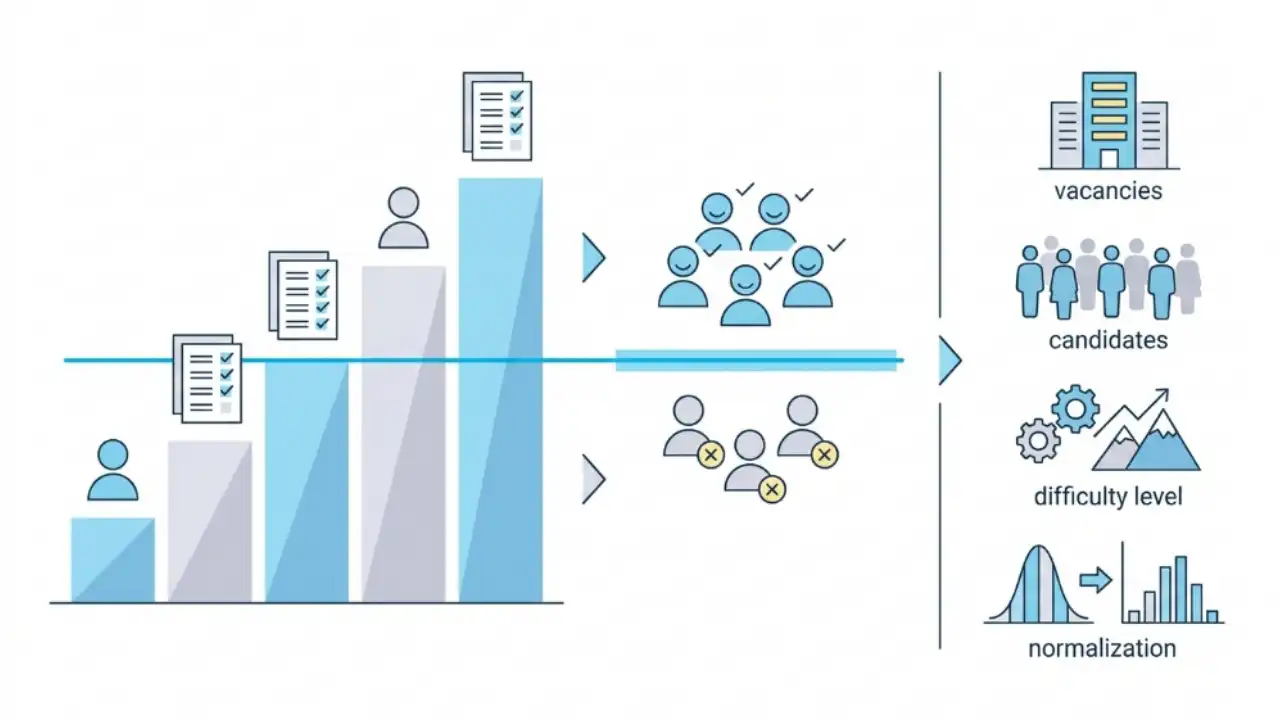
Many candidates assume that cut-off marks are fixed before an examination takes place. In reality, most recruiting agencies and examination authorities determine cut-offs only after analysing the actual performance of candidates. Factors such as vacancies, exam difficulty level, attendance, reservation policies, and score distribution play a significant role in deciding the final cut-off.

This is why the cut-off for the same examination can vary considerably from one year to another, even when the syllabus and exam pattern remain unchanged. Understanding the logic behind cut-off determination helps candidates set realistic score targets and evaluate their performance more accurately.
Table of Contents
What Is a Cut-Off and Why Is It Important?
A cut-off is the minimum score, marks, percentile, or rank required to qualify for the next stage of an examination or secure final selection. It acts as a benchmark that separates successful candidates from those who do not qualify.
In competitive examinations, the number of applicants is usually much higher than the available seats or vacancies. As a result, examination authorities need a systematic method to shortlist candidates. The cut-off serves this purpose by ensuring that only candidates who meet a certain performance standard proceed further in the selection process.

For example, if an examination attracts 10 lakh applicants for 5,000 vacancies, it would be impossible to conduct interviews or document verification for every candidate. A cut-off helps narrow down the candidate pool to a manageable number.
The role of cut-offs becomes even more important in highly competitive examinations where even a difference of one or two marks can significantly affect a candidate’s ranking.
The Purpose of Cut-Offs in Competitive Examinations
Cut-offs are not merely administrative tools. They are designed to maintain fairness and ensure that selection standards remain consistent despite variations in competition levels and examination difficulty.

Recruiting bodies use cut-offs to achieve several objectives.
First, they help identify the most deserving candidates from a large applicant pool. Second, they ensure that the number of shortlisted candidates matches the available vacancies or seats. Third, they maintain the quality and competitiveness of the selection process.
Without a cut-off system, managing large-scale examinations would become extremely difficult, especially in recruitment drives that receive millions of applications every year.
The Major Factors That Influence Cut-Off Marks
Several variables influence the final cut-off announced by an examination authority. No single factor determines the cut-off; rather, it is usually the result of a comprehensive analysis of candidate performance and recruitment requirements.
| Factor | Impact on Cut-Off |
|---|---|
| Number of Vacancies | More vacancies generally reduce cut-offs |
| Candidate Participation | Higher competition may increase cut-offs |
| Difficulty Level | Easier papers often result in higher cut-offs |
| Candidate Performance | Better overall performance raises cut-offs |
| Reservation Policies | Different categories may have different cut-offs |
| Normalization Process | Adjusted scores can affect final cut-offs |
| Stage-Wise Requirements | Shortlisting targets influences cut-off levels |
While these factors work together, vacancies and exam difficulty are often considered the most influential variables.
For example, if a recruitment board announces a large number of vacancies and the examination is difficult, the cut-off is likely to remain relatively low. On the other hand, if vacancies are limited and the paper is easy, the cut-off can rise significantly.
How Examination Authorities Actually Calculate Cut-Offs
The cut-off determination process begins only after answer evaluation is completed and candidate scores become available.
At this stage, examination authorities analyse the complete performance data of all candidates. They study the highest score, average score, score distribution, category-wise performance, and the number of candidates available within different score ranges.
The authority then compares this data with the number of vacancies or seats available.
For example, if 1,000 vacancies exist and the recruitment board wants approximately 15 candidates per vacancy for the next stage, it may decide to shortlist around 15,000 candidates. The score corresponding to the 15,000th candidate may effectively become the cut-off.
This approach ensures that the next stage of recruitment remains manageable while maintaining competition standards.
Understanding the Role of Vacancies
Vacancies have a direct impact on cut-off levels because they determine how many candidates need to be selected.
Consider the following example:
| Scenario | Vacancies | Applicants |
|---|---|---|
| Recruitment A | 10,000 | 5,00,000 |
| Recruitment B | 2,000 | 5,00,000 |
In Recruitment A, a larger number of candidates can be accommodated, which may result in a lower cut-off. In Recruitment B, fewer positions are available despite having the same number of applicants, leading to increased competition and a potentially higher cut-off.
This is one of the primary reasons why candidates closely monitor vacancy announcements before estimating expected cut-offs.
Why Exam Difficulty Matters So Much
The difficulty level of a question paper has a substantial impact on candidate performance and ultimately on cut-off marks.
When an examination is relatively easy, a large number of candidates score high marks. This creates intense competition near the top score ranges, forcing authorities to increase the cut-off.
In contrast, a difficult paper usually produces lower average scores. Since fewer candidates achieve high marks, the cut-off often decreases accordingly.
For instance, a score of 70 out of 100 may be considered average in an easy examination but exceptional in a particularly difficult one. Therefore, the raw score alone does not determine the cut-off; the overall performance context is equally important.
This explains why comparing cut-offs across different years without considering paper difficulty often leads to misleading conclusions.
The Importance of Normalisation in Multi-Shift Exams
Modern examinations are frequently conducted across multiple shifts spread over several days. Since different shifts may not have identical difficulty levels, examination authorities often apply normalisation techniques to ensure fairness.
Normalisation is a statistical process that adjusts candidate scores based on the relative difficulty of different shifts.
Imagine that candidates in Shift 1 received an easier question paper, while candidates in Shift 2 faced a tougher paper. Without normalisation, candidates from Shift 1 could gain an unfair advantage.
The normalisation process attempts to eliminate such disparities and place all candidates on a comparable scale.
| Shift | Average Score Before Normalisation |
|---|---|
| Shift 1 (Easier) | 78 |
| Shift 2 (Tougher) | 64 |
After normalisation, scores are adjusted so that candidates are evaluated more fairly regardless of the shift they attended.
Many major examinations, including SSC, Railway, Banking, and various state recruitment tests, use normalisation methods to maintain equity in the selection process.
Why Different Categories Have Different Cut-Offs
Government recruitment examinations in India typically follow reservation policies prescribed by law. As a result, separate cut-offs are often released for different categories.
These categories commonly include:
- General (UR)
- OBC
- EWS
- SC
- ST
- PwBD
- Ex-Servicemen
The cut-off for each category depends on the number of reserved vacancies and the level of competition within that category.
A category with fewer candidates competing for a larger proportion of reserved vacancies may have a lower cut-off compared to a category with intense competition.
This is why candidates often observe significant differences between category-wise cut-off scores in official result notifications.
A Practical Example of Cut-Off Determination
To understand the process more clearly, consider a hypothetical recruitment examination.
Suppose 2 lakh candidates appear for an examination offering 500 vacancies. The recruitment board decides to shortlist 10 times the number of vacancies for the next stage, meaning approximately 5,000 candidates need to qualify.
After evaluating answer sheets, the authority finds the following score distribution:
| Score Range | Number of Candidates |
|---|---|
| 90 and Above | 1,000 |
| 85–89 | 1,800 |
| 80–84 | 2,700 |
| 75–79 | 5,500 |
Since the board wants roughly 5,000 candidates for the next round, the cut-off may fall somewhere within the 80–84 score range.
The exact value would depend on category-wise distribution, normalisation outcomes, and tie-breaking rules.
This simplified example demonstrates that cut-offs emerge from candidate performance data rather than arbitrary decisions.
Common Myths About Cut-Off Marks
Several misconceptions continue to circulate among aspirants regarding cut-offs.
Some candidates believe that examination authorities predetermine cut-offs before conducting the exam. Others assume that previous-year cut-offs guarantee future trends.
In reality:
- Cut-offs are generally determined after result analysis.
- Previous-year cut-offs serve only as reference points.
- Higher vacancies do not always guarantee lower cut-offs.
- Difficult papers do not automatically ensure qualification.
- Normalisation can significantly influence final scores.
Understanding these realities helps candidates interpret examination results more accurately.
How Candidates Should Use Previous-Year Cut-Off Data
Previous-year cut-offs remain useful, but they should be used intelligently rather than blindly.
Aspirants should analyse trends across multiple years instead of focusing on a single examination cycle. Vacancy changes, exam difficulty, participation levels, and recruitment policies should all be considered alongside historical cut-off data.
The most effective strategy is to target scores comfortably above previous-year cut-offs rather than aiming for the minimum qualifying mark. Candidates who prepare with a margin of safety are less vulnerable to fluctuations caused by changing competition levels.
A strong score not only improves the chances of qualification but also provides greater confidence during the selection process.