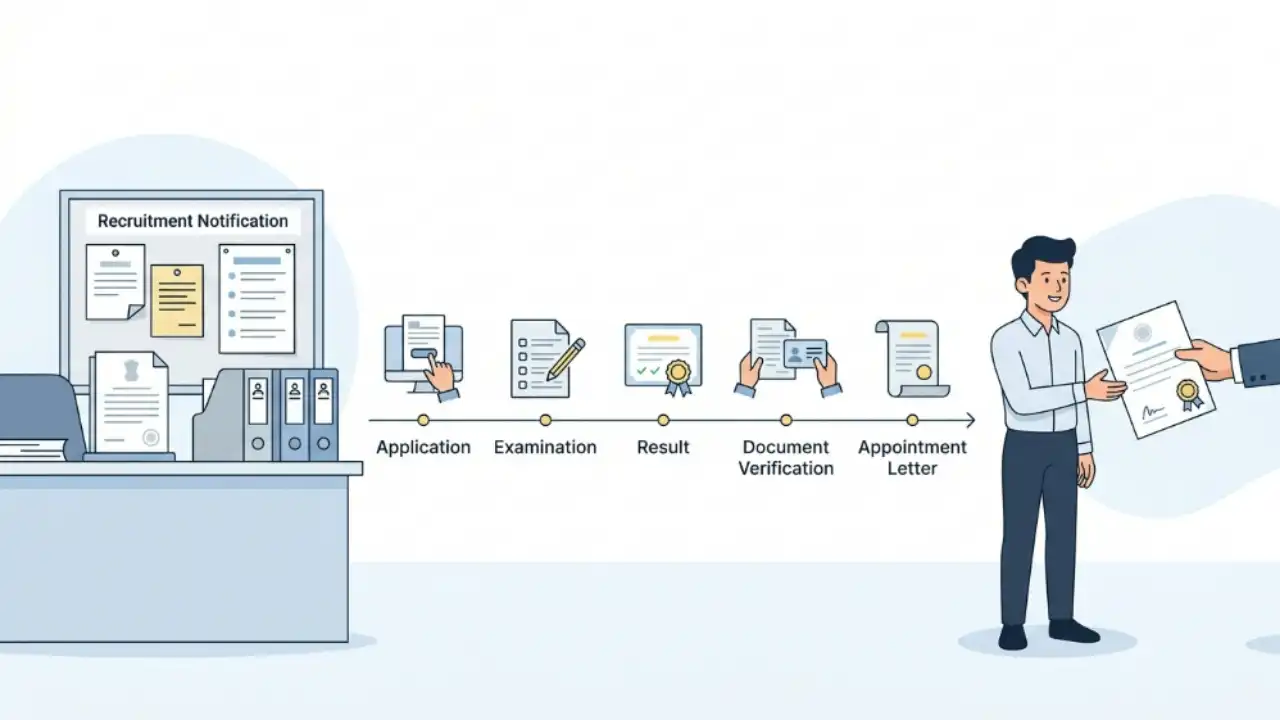
When candidates see a recruitment notification from SSC, UPSC, Railways, Banking, or a State Commission, the assumption is often that the government simply decided to hire people and released an advertisement. In reality, that notification is usually the result of months or sometimes years of administrative planning.
A government recruitment process begins long before an examination date is announced. Departments first identify workforce shortages, calculate retirement projections, assess future requirements, and seek financial approvals. Only after multiple layers of scrutiny does a vacancy become a recruitable position.

This hidden process explains why some recruitments are delayed despite apparent staff shortages and why vacancy numbers sometimes change before final notifications are issued.
Table of Contents
The First Step: How Vacancies Are Created
Every government department maintains a sanctioned strength and a working strength. The sanctioned strength refers to the total number of positions approved by the government, while the working strength reflects the number of employees currently serving.
Whenever a gap emerges due to retirement, resignation, promotion, death in service, or expansion of government services, the department identifies the need for recruitment.

Consider a department with 5,000 sanctioned posts. If 450 employees retire during a financial year and 200 new positions are approved under an expansion project, the department may seek recruitment for around 650 positions.
Major Reasons Vacancies Arise
| Reason | Impact on Recruitment |
|---|---|
| Retirement | Creates direct vacancies |
| Promotion | Creates vacancies at lower levels |
| Department Expansion | Generates new posts |
| New Government Schemes | Requires additional manpower |
| Backlog Recruitment | Fills reserved category vacancies |
The process appears simple on paper, but creating a vacancy and receiving permission to recruit are two different things.
Why Departments Cannot Hire Immediately
One of the biggest misconceptions among aspirants is that departments can start recruitment as soon as positions become vacant.

Government hiring is tied to budgetary approvals. Every vacancy represents a long-term financial commitment because the government must account for salary, allowances, pension liabilities, training costs, and administrative expenses.
As a result, departments must obtain approval from finance and administrative authorities before recruitment begins.
This is one reason why candidates often see thousands of vacant positions reported in parliamentary discussions while recruitment notifications take months to appear.
The Reservation Matrix: A Critical Stage That Often Causes Delays
Before vacancies can be advertised, departments prepare a reservation roster.
The roster determines how many positions are allocated to various categories under constitutional and statutory provisions. A small error in roster preparation can trigger legal challenges and delay an entire recruitment exercise.
For large recruitments involving thousands of posts, reservation calculations often become one of the most scrutinised stages of the process.
After reservation verification, departments send a formal recruitment request to agencies such as SSC, UPSC, Railway Recruitment Boards, or State Public Service Commissions.
What Recruitment Agencies Actually Do
Many candidates believe agencies like SSC and UPSC create vacancies. In reality, these organisations function as recruitment facilitators.
Their primary responsibility is to conduct a transparent selection process after receiving vacancy details from government departments.
Recruitment Agencies and Their Roles
| Agency | Primary Responsibility |
|---|---|
| SSC | Group B and Group C Central Government Posts |
| UPSC | Civil Services and Senior Government Posts |
| RRB | Railway Recruitment |
| IBPS | Public Sector Banking Recruitment |
| State PSCs | State Administrative Services |
Once requisitions arrive, agencies begin preparing recruitment calendars, examination schedules, and notification drafts.
From Official File to Public Notification
The notification stage is the first point at which candidates become involved in the recruitment process.
However, by the time a notification appears on an official website, significant groundwork has already been completed.
The recruitment notice serves as a legal document. It outlines eligibility conditions, reservation details, age limits, examination patterns, selection stages, and vacancy distribution.
Aspirants often focus only on application dates, but every line in a notification carries legal significance because future disputes are usually resolved based on the original advertisement.
Why Modern Government Examinations Are Massive Operations
Large-scale government examinations are among the biggest recruitment exercises in the world.
For example, major SSC, Railway, and banking examinations may attract millions of applications across India.
Managing such examinations requires:
- Secure question paper development
- Examination centre allocation
- Digital monitoring systems
- Biometric verification
- Cybersecurity safeguards
- Multi-layer security protocols
The logistical complexity explains why recruitment agencies spend months preparing for a single examination cycle.
What Happens After the Examination Ends?
Contrary to popular belief, evaluation begins long before candidates receive their results.
In computer-based examinations, candidate responses are stored instantly. Recruitment agencies then release provisional answer keys to improve transparency.
The objection window allows candidates to challenge answers they believe are incorrect. Subject experts review these objections before final answer keys are published.
Only after this process concludes are scores finalised.
How Merit Lists Are Actually Prepared
The merit list is not simply a ranking of marks obtained by candidates.
Several factors influence final selection:
| Component | Influence on Merit |
|---|---|
| Raw Score | Primary factor |
| Normalization | Applied in multi-shift exams |
| Reservation Rules | Category-wise selection |
| Tie-Breaking Rules | Used for equal scores |
| Document Verification | Determines eligibility |
This is why two candidates with similar marks may receive different outcomes depending on category, cut-off trends, and vacancy availability.
The Stage That Eliminates Many Candidates
Document verification receives far less attention than examination preparation, yet it remains one of the most important stages.
Every year, numerous candidates lose selection opportunities due to certificate discrepancies, invalid reservation claims, incorrect documentation, or eligibility issues.
Recruitment agencies verify educational qualifications, identity records, category certificates, disability certificates, and other supporting documents before final recommendations are issued.
Success in the written examination alone does not guarantee appointment.
Why Recruitment Delays Have Become Common
Candidates frequently criticise recruitment agencies for delays, but the reality is more complicated.
A recruitment cycle can be affected by:
- Court interventions
- Reservation disputes
- Examination malpractice investigations
- Budget revisions
- Administrative approvals
- Policy changes
- Election-related restrictions
Large recruitments involving lakhs of applicants require extensive verification processes, making delays almost inevitable in certain cases.
What Aspirants Should Learn From the Recruitment Process
Understanding how government recruitment works provides a competitive advantage. Candidates who understand the system are less likely to be influenced by rumours, unofficial vacancy claims, or misleading social media updates.
Instead of focusing solely on examination preparation, aspirants should monitor official notifications carefully, maintain updated documents, understand eligibility conditions, and track recruitment timelines realistically.
Government recruitment is not merely an examination; it is a lengthy administrative process designed to balance transparency, constitutional compliance, and merit-based selection.