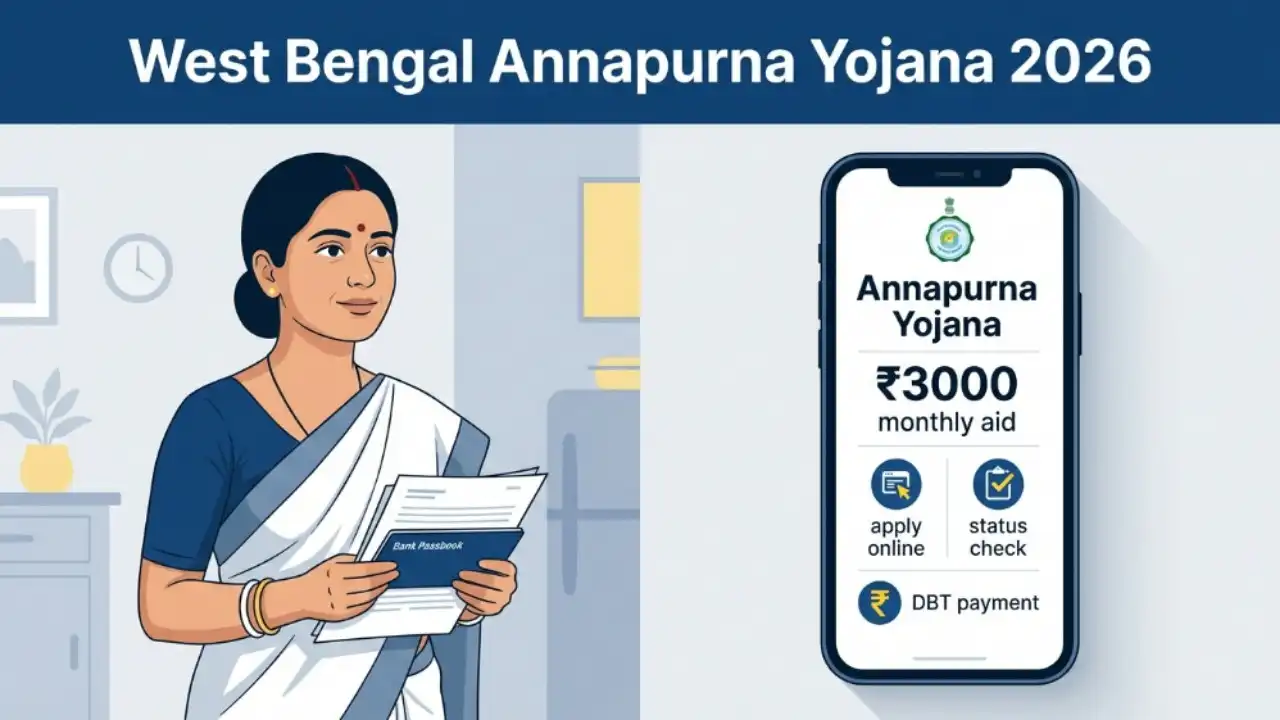
The West Bengal Government has moved ahead with the rollout of Annapurna Yojana 2026, a new financial assistance scheme for eligible women in the state. The scheme has been notified by the Department of Women & Child Development and Social Welfare, and it is scheduled to come into effect from June 1, 2026.
Under this scheme, eligible women will receive ₹3,000 per month as financial assistance. The amount will be transferred directly to the beneficiary’s Aadhaar-linked bank account through Direct Benefit Transfer, which means bank account status and Aadhaar seeding will play an important role in successful payment.

A dedicated Annapurna Yojana Portal has also been activated by the West Bengal Government. The portal currently provides options to track applicant status and download the application form in English, Bengali and Hindi. Fresh applicants and existing beneficiaries should use only the official portal or authorised government channels for any scheme-related process.
Table of Contents
Annapurna Yojana 2026 Latest Update
The latest update is that the West Bengal Government has listed the official notification for Annapurna Yojana and made the scheme portal available for public use. The notification has been listed by the Department of Women & Child Development and Social Welfare, while the digital portal is linked with status tracking and form download facilities.
The scheme is expected to start from June 1, 2026. From this date, the government will begin implementing the monthly assistance process for eligible women. Existing beneficiaries of Lakshmir Bhandar are also expected to be considered for migration under the new scheme, subject to verification and eligibility rules.

The portal’s activation is important because it gives applicants a direct online route to check scheme-related details. However, submission of details or migration from an existing database does not automatically mean final approval. Beneficiary records will be verified before the financial assistance is released.
Annapurna Yojana Benefit Amount
The main benefit under Annapurna Yojana is ₹3,000 per month for eligible women in West Bengal. If paid continuously for a full year, the total annual benefit may amount to ₹36,000 per beneficiary.
The financial assistance will be transferred through DBT, not through cash distribution. This makes Aadhaar-linked bank accounts necessary for smooth payment processing. Beneficiaries should make sure that their bank account is active, their Aadhaar is linked, and there is no mismatch in personal details.
The DBT system is expected to reduce manual delay and prevent duplicate or irregular payments. Still, applicants whose details are incomplete, mismatched or under verification may face delays until the concerned authority clears their records.
Who Can Apply for Annapurna Yojana?
Annapurna Yojana is meant for eligible women residents of West Bengal. As per the latest available details, the applicant should generally be between 25 and 60 years of age.
The applicant should not be an income taxpayer. Women who are permanent government employees are also not expected to be eligible under the scheme. Similarly, those receiving regular salary or pension from government bodies, local bodies, statutory bodies or government-aided institutions may be excluded.
The scheme will rely on official verification before final approval. This means applicants must provide correct family, identity, bank and residence details. Any false or mismatched information can affect approval or payment.
Annapurna Yojana Eligibility Conditions
The basic eligibility conditions reported so far are:
- The applicant must be a woman residing in West Bengal.
- The applicant should generally be between 25 and 60 years of age.
- The applicant should not be an income tax payer.
- The applicant should not be a permanent government employee.
- The applicant should not receive a regular salary or pension from the government, local body, statutory body or government-aided institutions.
- The applicant should have an Aadhaar-linked active bank account for DBT payment.
- The application or beneficiary record must pass official verification.
These conditions are important because the government is expected to remove ineligible, duplicate or unverifiable beneficiaries from the payment list. Applicants should keep all personal details consistent across Aadhaar, bank account, voter record and other identity documents.
What Will Happen to Lakshmir Bhandar Beneficiaries?
Existing Lakshmir Bhandar beneficiaries are expected to be migrated to Annapurna Yojana if they meet the required eligibility conditions. This migration may help many existing beneficiaries continue receiving women’s welfare support without starting the entire process from the beginning.
However, migration does not mean automatic payment for every existing record. Beneficiaries marked as deceased, shifted, deleted or absentee during official verification may be excluded from the new beneficiary list.
This is why existing beneficiaries should keep their personal details updated. If there is any mismatch in the bank account, Aadhaar, voter record or family details, it should be corrected through the authorised process whenever the correction facility is available.
Required Documents for Annapurna Yojana
Applicants should keep their basic identity, family, bank and residence details ready before applying. The official form is a family-level data collection form, so details of family members may also be required.
Important documents and details may include:
- Aadhaar Card of the applicant.
- Aadhaar-linked bank account details for DBT payment.
- Mobile number for communication and verification.
- Ration card or family household details, wherever applicable.
- Residential address details of the applicant.
- Family member details as required in the form.
- Income or employment-related declaration, if asked.
- Passport-size photograph, if required during offline submission.
- Declaration and consent as mentioned in the official form.
Applicants should ensure that the name, date of birth, Aadhaar details and bank details are consistent across documents. Any mismatch may delay verification or payment release.
How to Apply for Annapurna Yojana
Fresh applicants will be able to apply through the official process notified by the West Bengal Government. The online portal is expected to support the application process from the scheme rollout stage.
Applicants can follow these steps:
- Visit the official Annapurna Yojana Portal of the West Bengal Government.
- Download the application form available in English, Bengali or Hindi.
- Read all instructions carefully before filling the form.
- Enter personal details, Aadhaar details, address details and family information correctly.
- Fill in bank account details carefully, especially account number and Aadhaar-linked bank information.
- Attach or provide required documents as per the official process.
- Submit the application through the online portal or authorised government office, depending on the available facility.
- Keep the application number, acknowledgement receipt or reference details safe for future tracking.
- Wait for verification by the authorised officials.
- Check application status regularly through the official portal.
Applicants should not depend on private agents or unofficial websites. No payment should be made to anyone claiming to guarantee approval under the scheme.
Verification Process for Fresh Applicants
Fresh applications will go through administrative verification before approval. In rural areas, the verification process is expected to be handled through the Block Development Officer-level system.
In urban areas, Sub-Divisional Officers may be involved in the verification process. For applicants under Kolkata Municipal Corporation areas, the relevant KMC officials will handle the process.
Final approval will depend on the competent authority after verification of eligibility, identity, family information and bank details. Only verified and sanctioned beneficiaries will receive the monthly DBT payment.
How to Check Annapurna Yojana Status
The official Annapurna Yojana portal provides a Track Applicant Status option. This section can be used by applicants and beneficiaries to check the progress of their application or beneficiary record.
To check status, applicants can follow these steps:
- Visit the official Annapurna Yojana Portal.
- Click on the Track Applicant Status option available on the homepage.
- Enter the required details, such as application number, registered mobile number, Aadhaar-related details or other requested information.
- Submit the details after checking them carefully.
- View the current status of the application or beneficiary record.
- If the status shows pending, wait for completion of verification.
- If the status shows rejected or flagged, contact the concerned local office for clarification.
- Keep checking the portal for updated status and further instructions.
Applicants should use only the official portal for status tracking. Unofficial links may collect personal details and create privacy or fraud risks.
Important Points for Beneficiaries
Existing Lakshmir Bhandar beneficiaries should not panic if the migration process takes time. The government is expected to verify records before final migration and payment release.
Beneficiaries should make sure their Aadhaar-linked bank account is active. If the account is closed, inactive, frozen or not Aadhaar-seeded, DBT payment may fail even after approval.
Applicants should also keep their mobile number active. Any OTP, verification alert or application-related message may be sent to the registered mobile number during the process.