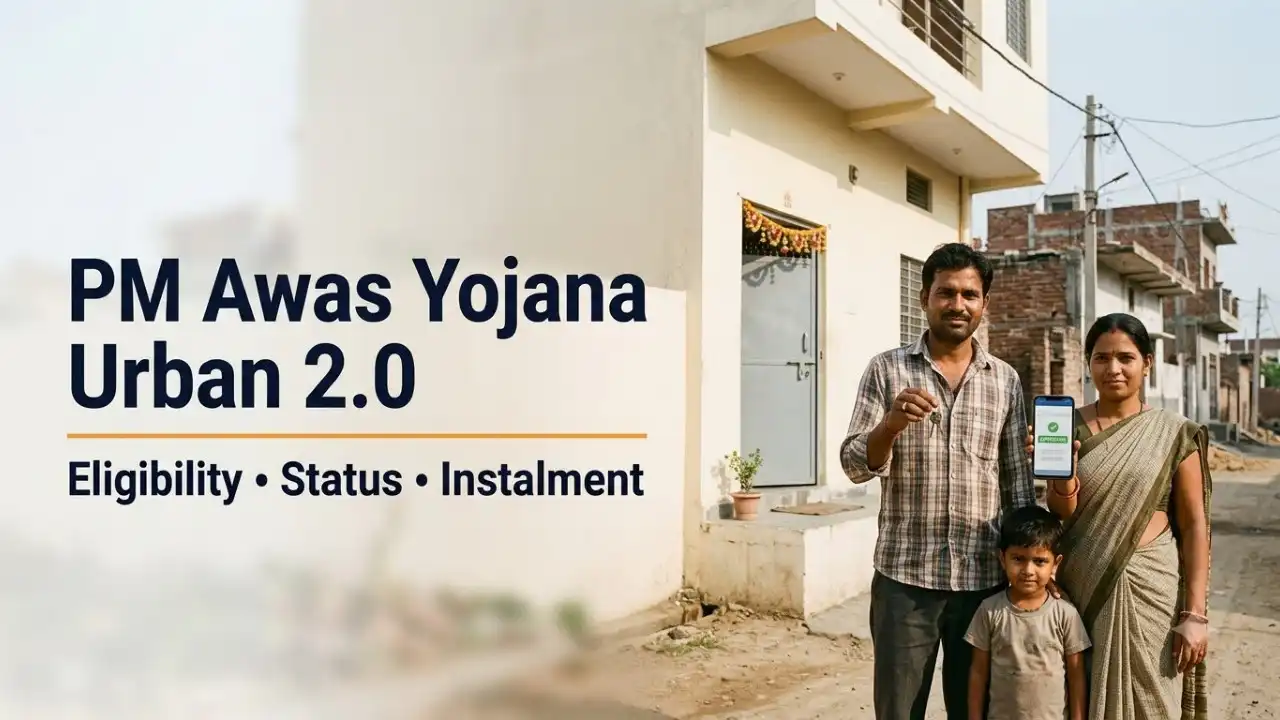
Pradhan Mantri Awas Yojana–Urban 2.0 (PMAY-U 2.0) is the Central Government’s flagship urban housing programme aimed at helping eligible poor and middle-class families construct, purchase or access an affordable home. The scheme is designed to support 1 crore urban families over five years, with government investment of about ₹10 lakh crore, including ₹2.30 lakh crore in Central assistance.
The scheme has moved into a significant implementation phase. The official PMAY-U 2.0 portal currently shows 71.55 lakh demands entered and around 18.78 lakh houses sanctioned across 5,206 cities and towns. In September 2026, the government said total sanctions under PMAY-U 2.0 had reached about 18.77 lakh.
Table of Contents
PMAY-U 2.0 Overview
| Particular | Details |
|---|---|
| Scheme | Pradhan Mantri Awas Yojana–Urban 2.0 |
| Implementing Ministry | Ministry of Housing and Urban Affairs |
| Target | 1 crore urban families |
| Scheme Period | 5 years from 2024-25 |
| Eligible Income Groups | EWS, LIG and MIG, depending on vertical |
| EWS Income | Up to ₹3 lakh annually |
| LIG Income | Up to ₹6 lakh annually |
| MIG Income | Up to ₹9 lakh annually |
| Main Components | BLC, AHP, ARH and ISS |
| Current Demand Entered | 71.55 lakh+ |
| Houses Sanctioned under PMAY-U 2.0 | About 18.78 lakh |
| Cities/Towns Covered | 5,206 |
The official portal figures are dynamic and can change as States, UTs and implementing agencies process additional demand and sanctions.
Who Is Eligible for PM Awas Yojana Urban 2.0?
A beneficiary family generally comprises the husband, wife, unmarried sons and unmarried daughters. Families belonging to EWS, LIG or MIG segments and living in urban areas should not own a pucca house anywhere in India, either in the applicant’s name or in the name of a family member.
Income classification is important because different components have different eligibility rules:
| Category | Annual Household Income |
|---|---|
| EWS | Up to ₹3 lakh |
| LIG | Up to ₹6 lakh |
| MIG | Up to ₹9 lakh |
Applicants also have to satisfy conditions concerning previous housing assistance. The PMAY-U 2.0 beneficiary undertakings include a declaration concerning housing-scheme benefits received by the applicant or family during the preceding 20 years. Eligibility is verified by the concerned authorities; simply submitting an application does not guarantee approval.
Four Ways to Get Benefit Under PMAY-U 2.0
PMAY-U 2.0 is not a single cash-transfer programme. Assistance depends on the vertical under which a beneficiary qualifies.
Beneficiary Led Construction (BLC): This is primarily for EWS families who have their own land and want to construct a new pucca house. The permissible house generally has 30-45 sq. metre carpet area. Renovation or extension of an existing house is not covered under the PMAY-U 2.0 BLC provision.
Affordable Housing in Partnership (AHP): Eligible beneficiaries can obtain affordable houses constructed through public or private partnership projects. Central assistance is provided for eligible EWS houses under this component.
Affordable Rental Housing (ARH): This component focuses on affordable rental accommodation, including housing for urban poor, working women, industrial workers and other eligible EWS/LIG households.
Interest Subsidy Scheme (ISS): EWS, LIG and MIG households taking eligible housing loans can receive interest subsidy subject to income, property value, loan amount and other conditions.
How Much PMAY-U Assistance Can You Get?

There is no universal “₹2.5 lakh payment” that every PMAY-U applicant automatically receives.
Under BLC/AHP, the funding pattern varies according to the State/UT category. For most States, the standard funding framework provides ₹1.50 lakh per unit from the Central Government and a minimum ₹1 lakh State share, while States can provide additional assistance. The scheme also requires a minimum beneficiary contribution under the prescribed funding framework.
For BLC specifically, assistance to the beneficiary can reach up to ₹2.50 lakh, depending on the applicable funding pattern.

The exact amount should therefore be checked against the applicant’s State/UT and selected scheme vertical rather than assuming every approved family will receive the same amount.
PMAY-U Instalment: When Is the Money Released?
This is particularly important for BLC beneficiaries.
Central assistance under BLC is released in three instalments in a 40:40:20 ratio, linked to physical construction progress. Payments are made through DBT to the beneficiary’s bank account. Construction progress is geo-tagged and subsequently monitored/approved by the ULB or implementing agency before subsequent funds are released.
Therefore, sanction of an application does not necessarily mean the complete assistance will be credited immediately.
BLC houses are expected to be completed within 12 to 18 months from sanction.
Home Loan Subsidy Under PMAY-U 2.0
Applicants purchasing or constructing a house with an eligible housing loan should understand the separate ISS rules.
Households with annual income up to ₹9 lakh, housing loans up to ₹25 lakh and property value up to ₹35 lakh may qualify. The scheme provides 4% interest subsidy on the first ₹8 lakh of the loan for a tenure of up to 12 years, subject to conditions.
The maximum actual interest subsidy release is ₹1.80 lakh, with an NPV of up to ₹1.50 lakh. The permissible carpet area is up to 120 sq. metres.
Unlike BLC construction assistance, the ISS subsidy is released in five equal yearly instalments into the loan account.
PM Awas Yojana Urban Beneficiary List: How to Check
Applicants searching for the “PM Awas Yojana Urban beneficiary list 2026” should distinguish between the older PMAY-U MIS and the PMAY-U 2.0 application system.
The legacy PMAY-U MIS continues to provide a Search Beneficiary – Search by Name facility for relevant beneficiary records.
For a PMAY-U 2.0 application, the more useful option is the Track Application Status service available through the official unified portal. The portal allows applicants to retrieve and monitor their submitted application rather than relying on unofficial “new beneficiary list” websites.
Applicants should remember that submission, survey inclusion, and final sanction are different stages.
How to Check PMAY-U 2.0 Application Status
Open the official PMAY-U 2.0 portal and select Citizen Services, then select Track Application Status. Use the requested application or identity details to retrieve the application.
The system is designed to provide real-time application tracking, while States/UTs, ULBs and implementing agencies can update the necessary information during processing.
A status such as “Application Submitted” means the application has been received; it should not be interpreted as confirmation that the house or financial assistance has already been sanctioned.
How to Apply for PM Awas Yojana Urban 2.0
Applicants can register their housing demand through the PMAY-U 2.0 Unified Web Portal. BLC applicants can also approach their concerned Urban Local Body (ULB) or implementing agency.
The application process involves an eligibility check, Aadhaar authentication, selection of the appropriate vertical and submission of household, income, bank and housing-related information. For BLC, proof of ownership of the land is particularly important.
Applicants should select their vertical carefully. The official eligibility page warns that once a vertical has been selected, it cannot subsequently be changed through the normal application process.
Who Gets Preference?
PMAY-U 2.0 gives preference to vulnerable groups including widows, single women, persons with disabilities, senior citizens, transgender persons, SC/ST communities, minorities and other weaker sections.
Special focus is also placed on Safai Karmis, PM SVANidhi street vendors, PM Vishwakarma artisans, Anganwadi workers, building and construction workers, and residents of slums or chawls.
Women also remain central to the housing programme. Government data released in 2026 stated that, across PMAY-U and PMAY-U 2.0, around 1 crore of the 1.25 crore sanctioned houses were allotted to women either in the female head’s name or through joint ownership.
PMAY-U 2.0 Latest Status in 2026
Implementation has accelerated during 2026. The government reported in September that PMAY-U 2.0 sanctions had reached approximately 18.77 lakh houses, after more than 29,000 additional houses were approved at the 9th Central Sanctioning and Monitoring Committee meeting.
The live portal subsequently displays approximately 18.78 lakh sanctioned houses and more than 71.55 lakh demands entered. These figures show why applicants should distinguish between demand/application data and actual sanctioned houses.