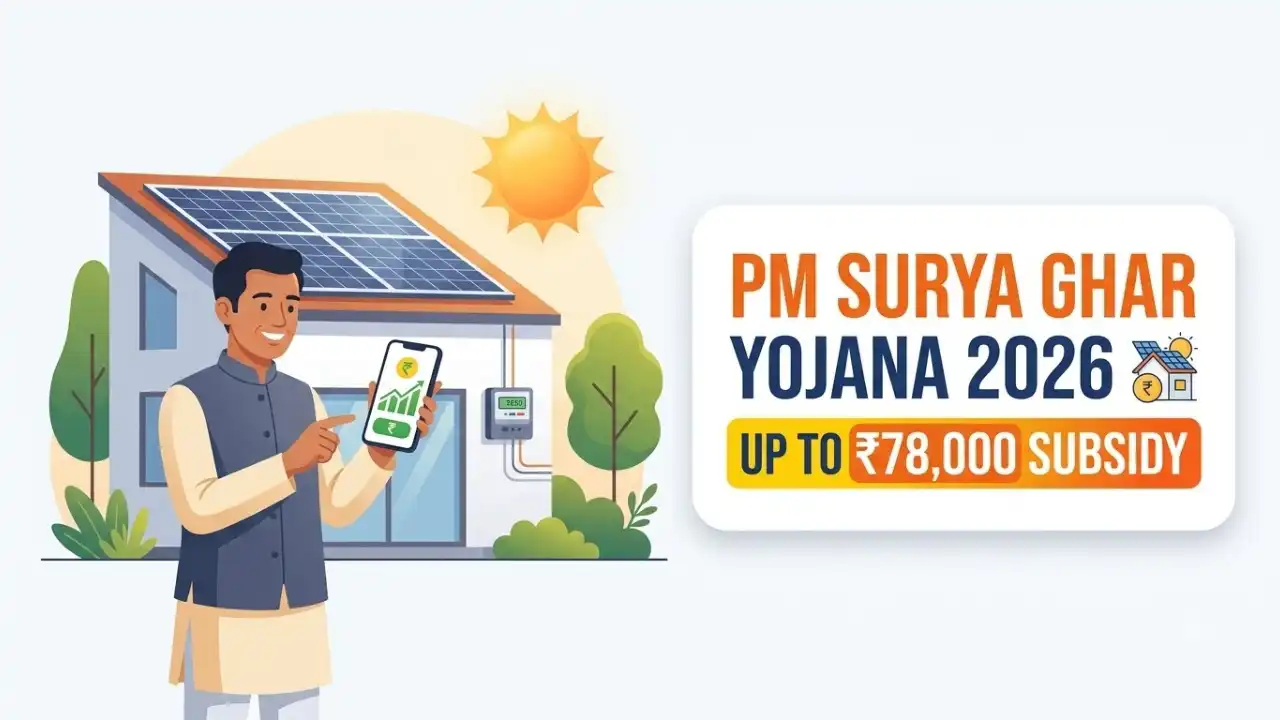
The PM Surya Ghar: Muft Bijli Yojana has emerged as one of India’s largest household renewable-energy programmes. Launched in February 2024, the scheme aims to bring rooftop solar to 1 crore households, helping families reduce electricity bills and, depending on their consumption and solar generation, potentially receive a zero electricity bill in some billing periods.
The programme has a total approved outlay of ₹75,021 crore. According to the latest consolidated government data located for this article, 51.58 lakh households were benefiting from rooftop solar under the scheme as of August 12, 2026. Around ₹28,024 crore in subsidy had been transferred, while cumulative rooftop solar capacity commissioned under the programme had reached 14.8 GW.
Table of Contents
PM Surya Ghar Yojana 2026 Overview
| Particular | Details |
|---|---|
| Scheme | PM Surya Ghar: Muft Bijli Yojana |
| Launched | 13 February 2024 |
| Target | 1 crore households |
| Total Outlay | ₹75,021 crore |
| Maximum standard Central subsidy | ₹78,000 |
| Subsidy-supported capacity | Up to 3 kW |
| Households benefiting | 51.58 lakh as of 12 August 2026 |
| Subsidy transferred | Around ₹28,024 crore |
| Solar capacity commissioned | 14.8 GW |
| Implementing Ministry | Ministry of New and Renewable Energy |
| Application Mode | Online through PM Surya Ghar National Portal |
The scheme’s progress has accelerated substantially. Government data released in August showed that more than 50 lakh households had crossed the rooftop-solar milestone, compared with 7.94 lakh installations recorded during the preceding ten years. July 2026 alone saw 5.06 lakh households benefit from installations.
How Much Subsidy Can You Get?
For most eligible residential consumers, the Central Financial Assistance structure is straightforward.
| Rooftop Solar Capacity | Standard Central Subsidy |
|---|---|
| 1 kW | ₹30,000 |
| 2 kW | ₹60,000 |
| 3 kW | ₹78,000 |
| Above 3 kW | ₹78,000 maximum |
The subsidy is effectively ₹30,000 per kW for the first 2 kW and ₹18,000 for the additional 1 kW. No additional Central subsidy is provided for capacity above 3 kW. Certain special-category areas have a higher CFA rate.

This distinction matters: ₹78,000 is not the cost of a 3 kW solar system and the government does not necessarily pay the entire installation cost. It is the maximum standard Central subsidy under the household CFA structure. The consumer generally pays the remaining cost.
Does PM Surya Ghar Really Give 300 Units of Free Electricity?
The often-used phrase “300 units free every month” requires some explanation.
The scheme enables households to generate their own electricity through rooftop solar. The government says a 3 kW rooftop system can generate more than 300 units per month on average, allowing households to reduce the electricity they purchase from the grid. Surplus electricity can also be exported under the applicable metering and DISCOM arrangements.

This does not mean every registered household automatically receives 300 grid units free irrespective of its solar generation or consumption.
Actual savings depend on the system size, sunlight, roof conditions, household consumption, local electricity tariff, net-metering arrangement and solar-system performance.
The impact is nevertheless significant. Government data showed that nearly 19 lakh households had received zero electricity bills, while more than 12 lakh households collectively earned ₹421 crore by selling surplus electricity during FY 2024-25. The reported average additional income among households exporting electricity was around ₹3,500 annually.
Who Is Eligible for PM Surya Ghar Yojana?
The scheme primarily covers residential electricity consumers. Applicants should generally meet these conditions:
- The applicant should be an Indian citizen.
- The household should have a valid electricity connection.
- There must be suitable space for installation of the rooftop solar system.
- The household should not have already received another subsidy for the same rooftop solar installation.
Official guidelines also allow an eligible residential consumer to install the system on a roof, terrace, balcony or suitable elevated structure, subject to technical feasibility and applicable requirements.
Group Housing Societies and Resident Welfare Associations can also receive CFA for eligible common facilities, including EV charging, subject to prescribed capacity limits.
What Size Solar System Should a Household Choose?
The right capacity should be based on electricity consumption rather than simply choosing the maximum subsidy.
A household with relatively low electricity consumption may find a smaller system sufficient, while a family regularly consuming around or above 300 units could consider a larger system after assessing roof space, generation potential and economics.
The National Portal provides tools to help consumers assess suitable capacity and compare registered vendors.
Importantly, subsidy is capped after 3 kW, so installing a 4 kW or 5 kW system does not increase the standard Central subsidy beyond ₹78,000.
Can You Get a Loan for Rooftop Solar?
Yes. Financing has become an important part of the programme.
As of July 2026, the government said eligible households could access collateral-free financing from nationalised banks at repo rate plus 50 basis points, which at that point translated to 5.75% per annum, with a tenure of up to 10 years. Because the rate is linked to the repo rate, consumers should check the applicable rate when applying rather than assuming 5.75% will remain fixed indefinitely.
By August 2026, loans had been sanctioned for 21.87 lakh applicants, while 17.5 lakh installations had been completed using loan financing.
How to Apply for PM Surya Ghar Muft Bijli Yojana
The application and subsidy process is handled through the PM Surya Ghar National Portal. The government describes the current system as an end-to-end digital process.
Broadly, a consumer needs to register using electricity-connection details, submit the rooftop-solar application, complete the required feasibility/approval process where applicable, select an eligible registered vendor, get the system installed, complete inspection and metering requirements, and submit the necessary bank details for subsidy processing.
Applicants should use the official National Portal rather than paying an unknown intermediary merely to “register” them.
How Long Does the Subsidy Take?
One major improvement has been integration with the Public Financial Management System. The government reported in August 2026 that this enables subsidy release within 15 days as part of the digital processing framework. Actual cases can still depend on successful completion of installation, inspection, documentation and other required steps.
The same update said API integration had been established with more than 80 DISCOMs, while digital net-metering agreements and vendor ratings had also been introduced.
What If a Family Cannot Afford the Upfront Cost?
This is another important development.
Apart from the normal consumer-owned or CAPEX model, the government has introduced RESCO and Utility-Led Aggregation (ULA) approaches. Under the RESCO model, a third party can invest in the rooftop system, allowing the household to use solar electricity without bearing the conventional full upfront installation cost. Under ULA, DISCOMs or state-designated entities can facilitate installations for residential households.
By August 2026, 1.6 lakh installations for PMAY, BPL and SC/ST households across four states had been completed through the Utility-Led Aggregation model, with rollout sanctioned in 12 states.
This could become one of the most important parts of PM Surya Ghar because the upfront investment remains a barrier for lower-income households even when a subsidy is available.
What Households Should Check Before Installing Solar
Consumers should not select a rooftop system solely because an installer promises a “zero electricity bill.” Actual savings are household-specific.
Before proceeding, check your previous electricity bills, usable shadow-free roof area, proposed system capacity, total quoted price before and after subsidy, equipment specifications, warranties, vendor status, expected annual generation, local DISCOM rules and the applicable net-metering arrangement.
A zero bill is possible for some consumers, but it should be viewed as an outcome of sufficient solar generation relative to consumption, not as an unconditional entitlement attached to registration.
FAQs
Is PM Surya Ghar Muft Bijli Yojana still available in 2026?
Yes. The scheme is being implemented with a target of covering one crore households and is scheduled under the approved framework through FY 2026-27.
What is the maximum Central subsidy?
The standard Central subsidy is capped at ₹78,000 for a 3 kW or larger eligible residential system.
Can I install more than 3 kW?
Yes, subject to technical and DISCOM requirements, but additional capacity above 3 kW does not receive additional Central CFA under the standard structure.
Will everyone get a zero electricity bill?
No. The final bill depends on solar generation, electricity consumption, tariff structure and metering arrangements. Nearly 19 lakh beneficiary households had reported zero bills for applicable billing periods by mid-2026.
Where should I apply?
Applications are handled through the official PM Surya Ghar National Portal managed under the Ministry of New and Renewable Energy.