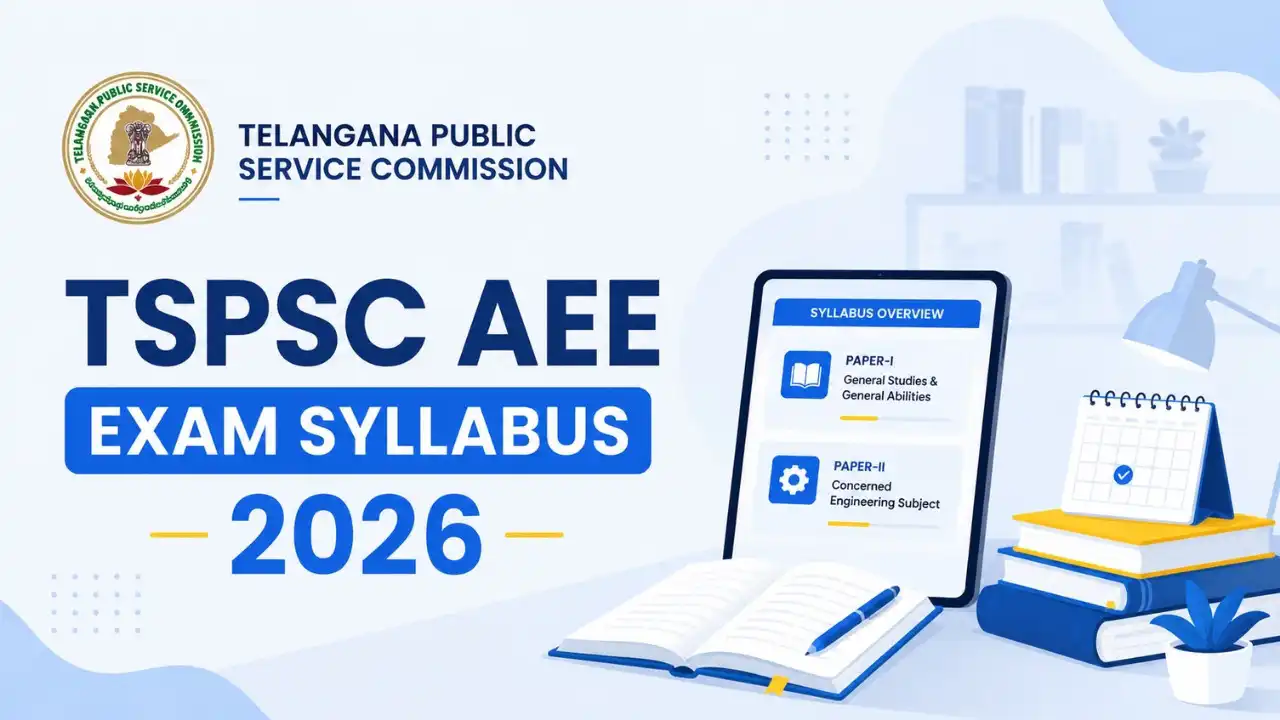
The Telangana Public Service Commission has released the detailed syllabus and examination scheme for Assistant Executive Engineer Civil, Assistant Executive Engineer Electrical, and Assistant Environmental Engineer posts. The notifications confirm that the examination will be an objective type and will carry 450 marks in total.
This recruitment is important for engineering graduates in Telangana as the notified posts cover the Roads and Buildings Department and the Telangana Pollution Control Board. As per the notifications, the Civil AEE exam is scheduled tentatively for October 2026, the Electrical AEE exam is also scheduled for October 2026, while the Assistant Environmental Engineer exam is tentatively planned for September 2026.
The exam scheme is broadly similar for all three posts. Paper-I will test General Studies and General Abilities, while Paper-II will focus on the concerned engineering subject. Paper-I will be bilingual in English and Telugu, while Paper-II will be in English only.
Table of Contents
TSPSC AEE Exam Pattern 2026
The written examination will be objective type. TSPSC may conduct the exam either in OMR-based offline mode or Computer-Based Recruitment Test mode. The final exam mode will be mentioned in the hall ticket or on the official website.
| Paper | Subject | Questions | Duration | Marks |
|---|---|---|---|---|
| Paper-I | General Studies and General Abilities | 150 | 150 minutes | 150 |
| Paper-II | Concerned Engineering Subject | 150 | 150 minutes | 300 |
| Total | 300 | 300 minutes | 450 |
This pattern shows that Paper-II will carry double weight compared to Paper-I. Candidates should not treat the technical paper as a regular qualifying section. It will likely decide the merit position because 300 out of 450 marks are allotted to the engineering subject.
Paper-I Syllabus: General Studies and General Abilities
Paper-I is common for Civil, Electrical, and Environmental posts. It will test a candidate’s awareness of current issues, Telangana-specific knowledge, reasoning, and basic English.
The official syllabus includes current affairs at regional, national, and international levels, international relations, general science, India’s achievements in science and technology, environmental issues, disaster management, economic and social development of India and Telangana, geography of India and Telangana, modern Indian history, Telangana history with special focus on the Statehood Movement, Indian Constitution, governance, public policy, social exclusion, rights issues, Telangana culture, Telangana policies, logical reasoning, analytical ability, data interpretation, and basic English up to Class 10 standard.
For serious aspirants, Telangana-specific topics should be treated as a high-priority area. Questions from Telangana history, society, policies, geography, economy, and Statehood Movement can create the difference between average and competitive scores.
TSPSC AEE Civil Syllabus 2026

For Assistant Executive Engineer Civil posts, Paper-II will be Civil Engineering at the degree level. The notification lists major technical areas from building materials, structures, RCC, steel design, hydraulics, environmental engineering, transportation engineering, soil mechanics, estimation, construction management, and surveying.
The major Civil Engineering topics include Building Materials and Construction, Strength of Materials, Theory of Structures, Reinforced Concrete Structures, Steel Structures, Fluid Mechanics, Hydrology, Water Resources Engineering, Environmental Engineering, Transportation Engineering, Soil Mechanics, Foundation Engineering, Estimation, Costing, Construction Management, Surveying, GPS, GIS, and electronic measuring instruments.
This syllabus is broad and degree-level in nature. Candidates should focus on conceptual clarity, formula-based problem solving, IS code-based fundamentals, and repeated revision of high-scoring subjects such as RCC, soil mechanics, transportation, strength of materials, surveying, and estimation.
TSPSC AEE Electrical Syllabus 2026
For Assistant Executive Engineer Electrical posts, Paper-II will be Electrical and Electronics Engineering at degree level. The syllabus is designed to test core engineering knowledge required for technical service roles.
Candidates should prepare topics such as electrical circuits, network analysis, electrical machines, power systems, generation, transmission and distribution, control systems, measurements and instrumentation, analog electronics, digital electronics, power electronics, electromagnetic theory, switchgear and protection, utilisation of electrical energy, and related degree-level concepts.
Electrical candidates should give more time to numerical-heavy areas such as machines, networks, power systems, control systems, and measurements. These subjects usually require repeated practice rather than one-time reading.
Assistant Environmental Engineer Syllabus 2026
For the Assistant Environmental Engineer in the Telangana Pollution Control Board, Paper-II will be the concerned subject. The official syllabus includes a wide technical spread covering ecosystems, natural resources, biodiversity, engineering materials, environmental pollution, water and wastewater treatment, air pollution, solid waste, environmental laws, and allied engineering concepts.
Important areas include ecosystems, food chains, food webs, ecological pyramids, biogeochemical cycles, bioaccumulation, biomagnification, natural resources, water resources, floods and droughts, dams, mineral resources, energy resources, biodiversity, national biodiversity law, engineering materials, and environmental engineering concepts.
Since this post is linked to the Pollution Control Board, candidates should give special attention to environmental pollution, pollution control methods, air and water quality standards, waste management, environmental legislation, and practical environmental monitoring concepts.
Selection Process and Qualifying Marks
The selection will be based on marks secured in the written examination. The notifications mention the minimum qualifying marks category-wise. OC, Sports Persons and EWS candidates need not less than 40%, BC candidates need not less than 35%, and SC, ST and PH candidates need not less than 30%.
However, securing minimum qualifying marks does not guarantee selection. Final selection will depend on examination performance, vacancy position, reservation rules, certificate verification, and other conditions mentioned in the notification.
Preparation Strategy for TSPSC AEE 2026
Candidates should divide preparation into two tracks. Paper-I requires daily reading, Telangana-focused revision, reasoning practice, and current affairs coverage. Paper-II requires structured technical preparation, formula revision, subject-wise notes, and mock tests.
A practical preparation plan should begin with the technical paper because it carries 300 marks. Candidates should complete core engineering subjects first, then revise weaker areas, and finally shift to mock tests and previous exam-style questions. For Paper-I, daily study of current affairs, Telangana history, policies, geography, Constitution, and reasoning is necessary.
The best approach is to maintain a short revision notebook. Civil candidates should write down formulas, IS code basics, estimation methods, soil mechanics concepts, and transportation design points. Electrical candidates should maintain notes on machine equations, network theorems, power system formulas, and measurement concepts. Environmental candidates should revise pollution standards, treatment processes, biodiversity concepts, and environmental law-related topics.
Why the Syllabus Needs Careful Reading
The TSPSC AEE syllabus is not limited to a few popular engineering subjects. It covers degree-level knowledge in a wide manner and gives major weight to Paper-II. This means candidates cannot depend only on General Studies or last-minute preparation.
The exam also includes Telangana-specific content in Paper-I. Candidates from engineering backgrounds often ignore this part, but 150 marks are allotted to General Studies and General Abilities. A strong score in Paper-I can improve the final ranking, especially when technical paper scores are close.
For candidates applying to more than one relevant post, the common Paper-I syllabus is an advantage. A well-prepared General Studies base can support performance across Civil, Electrical and Environmental exams, while Paper-II should be handled separately according to the chosen discipline.