India’s government recruitment ecosystem is one of the largest employment systems in the world, and the Staff Selection Commission (SSC) sits at the center of it. Every year, millions of aspirants apply for SSC examinations to secure central government jobs across ministries, departments, offices, tribunals, tax authorities, intelligence agencies, and public institutions.
For beginners, however, the SSC ecosystem often appears confusing. Different exams have different qualification requirements, salary structures, age limits, and promotion opportunities. Many candidates know the names of exams like SSC CGL or SSC CHSL but do not understand how these exams fit into the broader government recruitment hierarchy.

This guide explains the complete SSC structure in simple language. It covers the major SSC examinations, eligibility hierarchy, salary systems, departmental postings, promotion pathways, and preparation ecosystem. Whether you are a Class 10 pass student, a Class 12 candidate, or a graduate preparing for government jobs, this article will help you understand how the SSC recruitment system works in India.
Table of Contents
What is SSC?
The Staff Selection Commission (SSC) is a recruitment organization under the Government of India. It works under the Department of Personnel and Training (DoPT) and is responsible for conducting recruitment examinations for various central government departments and ministries.
SSC recruits candidates for Group B and Group C posts in different government offices. These jobs include administrative positions, clerical jobs, tax-related posts, investigation roles, intelligence work, engineering services, constable recruitment, and stenographer positions.

SSC was established in 1975 and has gradually become one of India’s largest recruitment agencies. Today, SSC examinations attract applicants from nearly every state because of stable salaries, job security, pension-related benefits, and promotion opportunities.
The recruitment process is fully centralized. SSC conducts examinations, prepares merit lists, verifies documents, and allocates departments based on rank, category, and preference submitted by candidates.
How the SSC Recruitment System Works
SSC functions as a centralized examination body. Instead of every ministry conducting separate recruitment tests, SSC conducts national-level examinations for multiple departments through one standardized process.

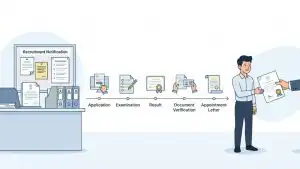
The process usually follows these stages:
- Notification Release
- Online Application
- Computer-Based Examination
- Skill Test or Physical Test (if applicable)
- Document Verification
- Final Selection and Department Allocation
Most SSC exams now use Computer-Based Tests (CBT). The examination process has become faster compared to earlier years, though final recruitment can still take several months.
SSC examinations are conducted in multiple tiers. A candidate first clears preliminary stages and then moves toward descriptive exams, skill tests, physical tests, or interviews depending on the post.
SSC Exam Hierarchy Explained
SSC examinations are divided according to educational qualification and job category. Understanding this hierarchy is extremely important for beginners.
SSC Exams After Class 10
Candidates who have passed Class 10 can apply for certain SSC recruitments.
Major exams include:
- SSC MTS (Multi-Tasking Staff)
- SSC GD Constable
- Havaldar Recruitment
These jobs usually involve support staff, field duties, security services, and operational assistance.
The competition level is high because of the massive applicant pool, but the syllabus is comparatively easier than graduate-level exams.
SSC Exams After Class 12
Candidates who have passed Class 12 become eligible for clerical and administrative support positions.
Major exams include:
- SSC CHSL
- SSC Stenographer
- Certain Delhi Police recruitments
These posts offer office-based government jobs with stable promotion opportunities.
SSC Exams After Graduation
Graduate-level SSC exams provide access to some of the most sought-after central government jobs in India.
Major graduate-level exams include:
- SSC CGL
- SSC CPO
- SSC JE (specific qualifications required)
- SSC Selection Post
- Junior Hindi Translator (JHT)
These posts often include Inspector-level jobs, Assistant Section Officer positions, tax departments, investigative agencies, audit services, and engineering services.
Major SSC Exams in India
SSC CGL (Combined Graduate Level Examination)
SSC CGL is the flagship recruitment examination conducted by SSC. It is considered one of the most prestigious non-UPSC government recruitment exams in India.
The examination recruits candidates for Group B and Group C posts in ministries, departments, and constitutional bodies.
Popular Posts Under SSC CGL
- Income Tax Inspector
- GST Inspector
- Assistant Section Officer
- Central Excise Inspector
- Auditor
- Accountant
- Assistant Enforcement Officer
- Sub Inspector (CBI)
- Statistical Investigator
- Preventive Officer
- Examiner
Eligibility
Candidates must hold a bachelor’s degree from a recognized university.
Certain posts require specialized qualifications such as statistics, economics, or mathematics.
Exam Structure
SSC CGL generally includes:
- Tier 1: Preliminary CBT
- Tier 2: Advanced CBT
- Skill/Typing Tests for specific posts
Salary Range
Most SSC CGL posts fall under Pay Level 4 to Pay Level 8.
Approximate monthly in-hand salary:
- ₹35,000 to ₹80,000 depending on city and department
Why SSC CGL is Popular
SSC CGL provides:
- Strong promotion opportunities
- Central government status
- High social reputation
- Departmental transfers
- Pension-related benefits
- DA, HRA, TA allowances
Many aspirants consider SSC CGL the best alternative to UPSC Civil Services because of its balance between workload, salary, and work-life stability.
SSC CHSL (Combined Higher Secondary Level)
SSC CHSL is conducted for candidates who have passed Class 12.
The exam mainly recruits candidates for clerical and administrative support positions.
Popular Posts Under SSC CHSL
- Lower Division Clerk (LDC)
- Junior Secretariat Assistant (JSA)
- Postal Assistant
- Sorting Assistant
- Data Entry Operator (DEO)
These posts usually involve desk work, file handling, administrative operations, data entry, and office management.
Eligibility
Candidates must have passed Class 12 from a recognized board.
Exam Pattern
SSC CHSL generally includes:
- Tier 1 Objective Exam
- Tier 2 Descriptive/Skill Test
- Typing Test
Salary Structure
Approximate monthly salary:
- ₹25,000 to ₹45,000
Postal Assistant and Sorting Assistant positions are often preferred because of better allowances and work environment.
SSC GD Constable
SSC GD is one of the largest recruitment examinations in India in terms of applicant volume.
The examination recruits constables for various paramilitary forces.
Forces Covered Under SSC GD
- BSF
- CISF
- CRPF
- ITBP
- SSB
- Assam Rifles
- SSF
Eligibility
Candidates must have passed Class 10.
Selection Process
The process usually includes:
- Computer-Based Test
- Physical Efficiency Test (PET)
- Physical Standard Test (PST)
- Medical Examination
Nature of Work
SSC GD jobs involve:
- Border security
- Internal security
- Industrial security
- Anti-insurgency operations
- Crowd management
Salary
Approximate in-hand salary:
- ₹30,000 to ₹45,000
Risk allowances and field postings significantly influence the total package.
SSC MTS (Multi Tasking Staff)
SSC MTS recruits candidates for support staff roles in central government offices.
Nature of Work
Responsibilities may include:
- Office file movement
- Record maintenance
- Basic administrative support
- Office assistance
- Dispatch and delivery work
Eligibility
Class 10 pass.
Salary
Approximate salary:
- ₹22,000 to ₹35,000
Although entry-level in nature, MTS jobs provide stable government employment and long-term financial security.
SSC CPO (Central Police Organization)
SSC CPO recruits Sub Inspectors for Delhi Police and Central Armed Police Forces.
Popular Posts
- Sub Inspector in Delhi Police
- Sub Inspector in BSF
- Sub Inspector in CISF
- Sub Inspector in CRPF
- Sub Inspector in ITBP
- Sub Inspector in SSB
Eligibility
Graduation from a recognized university.
Selection Process
- Tier 1 CBT
- Physical Test
- Tier 2 CBT
- Medical Examination
Salary
Approximate monthly salary:
- ₹45,000 to ₹70,000
These posts are considered highly respected because they combine authority, field responsibility, and promotion opportunities.
SSC JE (Junior Engineer)
SSC JE is conducted for engineering diploma and degree holders.
Streams Included
- Civil Engineering
- Mechanical Engineering
- Electrical Engineering
Departments
- CPWD
- MES
- BRO
- CWC
- Farakka Barrage
- Military Engineering Services
Salary
Approximate salary:
- ₹45,000 to ₹75,000
Engineering candidates often prefer SSC JE because of government infrastructure exposure and departmental growth.
SSC Stenographer
SSC Stenographer recruits candidates skilled in shorthand and typing.
Grades
- Grade C
- Grade D
Work Profile
- Dictation handling
- Documentation
- Ministerial support
- Administrative coordination
Eligibility
Class 12 pass.
Candidates must qualify shorthand skill tests.
SSC Selection Post
SSC Selection Post recruitment covers multiple vacancies across different qualification levels.
The examination is divided into:
- Matriculation Level
- Higher Secondary Level
- Graduate Level
Vacancies vary every year depending on departmental requirements.
SSC Salary Structure Explained
One of the biggest attractions of SSC jobs is the structured salary system.
Central government employees receive salaries under the 7th Pay Commission framework.
Components of SSC Salary
The salary generally includes:
- Basic Pay
- Dearness Allowance (DA)
- House Rent Allowance (HRA)
- Transport Allowance (TA)
- Medical Benefits
- Pension-related benefits
The actual in-hand salary depends on:
- City category (X, Y, Z cities)
- Department
- Posting location
- Risk allowances
- Field duties
SSC Pay Levels Explained
SSC posts are divided into pay levels.
| Pay Level | Approximate Basic Pay | Common Posts |
|---|---|---|
| Level 1 | ₹18,000 | MTS |
| Level 2-4 | ₹19,900–₹25,500 | CHSL Posts |
| Level 4-6 | ₹25,500–₹35,400 | GD, CPO |
| Level 6-8 | ₹35,400–₹47,600 | CGL Inspector Posts |
| Level 8-10 | ₹47,600+ | Senior Administrative Roles |
Higher pay levels generally mean stronger promotion opportunities and greater departmental authority.
Best SSC Posts for Beginners
Different aspirants prioritize different factors such as salary, work-life balance, promotion speed, location preference, or authority.
Best SSC Posts for Salary
- Assistant Audit Officer
- Assistant Accounts Officer
- Income Tax Inspector
- GST Inspector
- Assistant Enforcement Officer
Best SSC Posts for Work-Life Balance
- Auditor
- Accountant
- Assistant Section Officer
- Postal Assistant
Best SSC Posts for Authority
- CBI Sub Inspector
- Excise Inspector
- Preventive Officer
- Delhi Police SI
Best SSC Posts for Quick Entry
- SSC CHSL
- SSC MTS
- SSC GD
The “best” SSC job ultimately depends on career goals and educational background.
Promotion System in SSC Jobs
Promotion opportunities vary by department.
Some departments offer faster growth while others provide stable but slower career progression.
Example Promotion Chains
Income Tax Department
Tax Assistant → Senior Tax Assistant → Inspector → Superintendent → Assistant Commissioner
GST Department
Tax Assistant → Inspector → Superintendent → Assistant Commissioner
Central Secretariat
Assistant Section Officer → Section Officer → Under Secretary → Deputy Secretary
SSC CHSL Posts
LDC → Upper Division Clerk → Assistant Section Officer
Promotions may occur through:
- Departmental examinations
- Seniority
- Performance records
- Vacancy availability
Departments like Income Tax and GST are often preferred because of relatively faster promotions.
SSC vs UPSC: Major Difference
Many beginners confuse SSC and UPSC recruitment systems.
SSC
- Conducts recruitment for Group B and Group C jobs
- Easier syllabus compared to UPSC
- Faster preparation cycle
- Larger number of vacancies
- More practical for average aspirants
UPSC
- Conducts Civil Services Examination
- Recruits IAS, IPS, IFS officers
- Extremely competitive
- Larger syllabus
- Longer preparation timeline
SSC examinations are often considered more accessible and financially practical for middle-class aspirants.
SSC Preparation Ecosystem in India
The SSC preparation ecosystem has expanded rapidly over the last decade.
Today, candidates prepare through:
- Coaching institutes
- Online classes
- YouTube channels
- Telegram groups
- Mock test platforms
- PDF notes
- Mobile applications
The digital education boom has made SSC preparation accessible even in small towns.
Core Subjects in SSC Exams
Most SSC exams revolve around four major sections.
Quantitative Aptitude
Topics include:
- Arithmetic
- Algebra
- Geometry
- Mensuration
- Data Interpretation
Reasoning
Includes:
- Coding-Decoding
- Puzzles
- Series
- Analogy
- Non-verbal reasoning
English Language
Tests:
- Grammar
- Vocabulary
- Reading comprehension
- Error detection
General Awareness
Includes:
- Current affairs
- Static GK
- Polity
- History
- Geography
- Economy
- Science
General Awareness often becomes the deciding factor in merit rankings.
How Long Does SSC Preparation Take?
Preparation time depends on educational background and consistency.
Average Preparation Timelines
- Beginners: 10–18 months
- Intermediate aspirants: 6–10 months
- Experienced candidates: 3–6 months
Candidates from mathematics backgrounds may prepare faster for aptitude-heavy exams.
Consistency matters more than study duration alone.
Common Mistakes Made by SSC Aspirants
Many candidates spend years preparing without understanding the examination strategy.
Major Mistakes
- Preparing multiple exams without a plan
- Ignoring mock tests
- Spending excessive time on difficult mathematics
- Weak current affairs revision
- Lack of sectional time management
- Following too many teachers or sources
- Ignoring previous year papers
SSC preparation rewards disciplined repetition more than random studying.
Importance of Previous Year Papers
Previous year papers are among the most valuable SSC preparation resources.
They help candidates understand:
- Question trends
- Difficulty level
- Topic weightage
- Time management
- Repeated concepts
Many successful candidates solve 5–10 years of previous papers multiple times before the examination.
Role of Mock Tests in SSC Preparation
Mock tests are essential because SSC examinations are speed-based.
Candidates often know concepts but fail because of poor time management.
Regular mock tests improve:
- Accuracy
- Speed
- Section balancing
- Stress management
- Exam temperament
Mock analysis is often more important than the mock itself.
Is SSC a Good Career Option?
For millions of Indian aspirants, SSC remains one of the most reliable career paths.
Advantages of SSC Jobs
- Stable income
- Government benefits
- Job security
- Pension-related support
- Medical benefits
- Social reputation
- Promotion opportunities
- Work-life balance in many departments
Challenges
- High competition
- Slow recruitment cycles
- Transfer policies in some departments
- Repetitive work in certain posts
Despite challenges, SSC jobs continue to attract massive applicant pools because they provide long-term financial stability.
Future of SSC Recruitment in India
The SSC ecosystem is evolving continuously.
Recent years have seen:
- Fully online examinations
- Faster result processing
- Normalization systems
- AI-based monitoring
- Increased transparency
At the same time, competition levels have increased sharply because of rising unemployment and growing awareness about government careers.
Experts expect SSC recruitment to remain one of India’s largest employment channels over the next decade.
For Aspirants
SSC examinations provide one of the most structured entry routes into central government employment in India. From Class 10 level jobs to prestigious graduate-level Inspector posts, SSC offers opportunities for candidates from diverse educational backgrounds.
Understanding the hierarchy is extremely important before starting preparation. A Class 10 candidate may target SSC GD or MTS, while graduates may focus on SSC CGL or CPO depending on career goals. Choosing the correct examination early helps candidates build a focused preparation strategy.
The SSC ecosystem is highly competitive, but it remains achievable for disciplined aspirants. Candidates who consistently practice aptitude, revise previous year papers, attempt mock tests, and maintain long-term consistency often succeed even without expensive coaching systems.