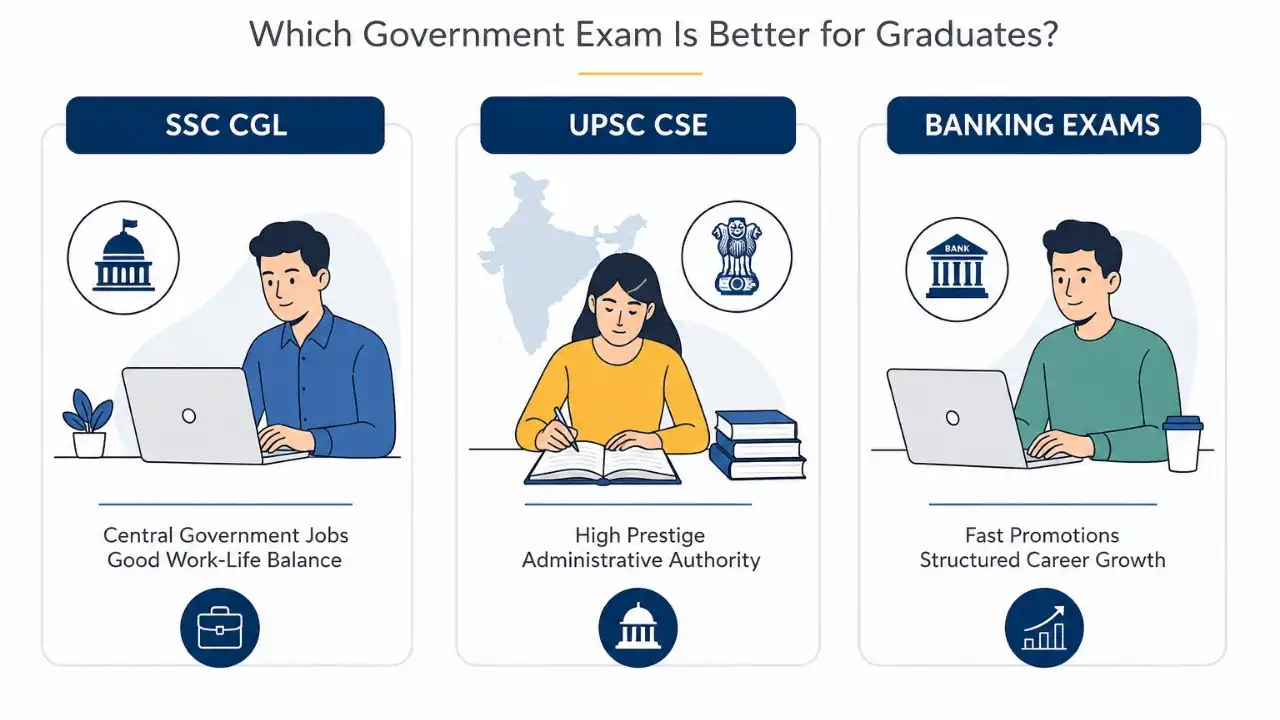
Every year, millions of Indian graduates prepare for government exams hoping to secure stable jobs, better salaries, and long-term career growth. Among all competitive exams, SSC CGL, UPSC Civil Services, and Banking Exams remain the three biggest career choices for aspirants across India.
While all three offer respectable government careers, the preparation style, competition level, salary structure, work pressure, and career growth are completely different. Many students spend months preparing without clearly understanding which exam actually matches their strengths, lifestyle goals, and long-term expectations.
Table of Contents
Why SSC CGL Has Become the First Choice for Many Graduates

SSC CGL has rapidly become one of the most preferred government exams because it offers central government jobs with comparatively lower preparation pressure than UPSC. Posts like Income Tax Inspector, Assistant Section Officer, CBI Sub-Inspector, and Examiner continue to attract lakhs of candidates every year.
The exam pattern is considered more predictable compared to UPSC. Questions mainly focus on Quantitative Aptitude, English, General Awareness, and Reasoning. Candidates with strong speed and practice often perform well even without highly academic backgrounds.
Another major reason behind SSC CGL’s popularity is its balance between salary and work-life stability. Most posts offer decent promotions, urban postings, fixed working hours, and fewer transfers compared to several banking and civil services roles.
SSC CGL Highlights
- Moderate competition compared to UPSC
- Central government Group B and Group C jobs
- Good work-life balance in many departments
- Faster preparation cycle for beginners
- Salary range generally between ₹45,000 to ₹80,000 per month initially
Why UPSC Still Remains India’s Most Prestigious Exam

UPSC Civil Services Examination continues to carry unmatched prestige in India. IAS, IPS, and IFS officers are directly involved in administration, policymaking, law enforcement, and governance. This level of authority makes UPSC the dream exam for many aspirants.
However, UPSC is also considered the toughest competitive exam in India due to its vast syllabus, subjective answer writing, and extremely low selection ratio. Candidates usually spend multiple years preparing for the Prelims, Mains, and Interview stages.
Unlike SSC CGL or Banking Exams, UPSC preparation demands a deep conceptual understanding of subjects such as history, geography, polity, economics, ethics, and current affairs. Consistency over long periods becomes more important than speed-based solving.
UPSC Highlights
- Highest prestige among government exams
- Administrative authority and policymaking roles
- Very wide and unpredictable syllabus
- Multi-stage selection process with an interview
- The success rate is usually below 1%
How Banking Exams Offer Faster Recruitment and Promotions

Banking exams conducted through IBPS, SBI, and RBI attract graduates looking for quicker recruitment cycles and strong promotion opportunities. SBI PO and IBPS PO remain among the most targeted exams in the banking sector.
Compared to UPSC, banking exams are more speed-oriented and aptitude-heavy. The preparation focuses mainly on Quantitative Aptitude, Reasoning, English, and Banking Awareness. Candidates with strong calculation speed and accuracy often adapt quickly.
One major advantage of banking careers is structured promotion systems. Probationary Officers can rise to managerial positions relatively quickly compared to many SSC departments. However, work pressure, sales targets, and transfer frequency can be higher in banking jobs.
Major Difference Between SSC CGL, UPSC, and Banking Exams
| Factor | SSC CGL | UPSC | Banking Exams |
|---|---|---|---|
| Difficulty Level | Moderate | Very High | Moderate |
| Selection Process | Tier Exams | Prelims, Mains, Interview | Prelims, Mains, Interview |
| Syllabus Size | Medium | Extremely Vast | Medium |
| Work-Life Balance | Good | Depends on Posting | Moderate |
| Salary Growth | Stable | Very High | Fast Promotions |
| Transfers | Limited in many posts | Frequent | Frequent |
| Competition Level | High | Extremely High | High |
| Preparation Duration | 6-12 Months | 2-3 Years Often | 6-12 Months |
Which Exam Is Better for Average Graduates?
For graduates looking for stable central government jobs with manageable preparation, SSC CGL is often considered the safest option. The syllabus is relatively limited, preparation resources are easily available, and multiple posts are offered every year.
UPSC is generally better suited for aspirants willing to dedicate several years with a strong interest in administration, governance, and public service. It demands emotional resilience, patience, and deep academic consistency.
Banking exams work well for candidates comfortable with fast-paced environments, customer-facing roles, targets, and frequent transfers. Aspirants who enjoy aptitude-based preparation usually perform better in banking recruitment exams.
Before Choosing an Exam, Graduates Should Consider
- Personal interest and long-term career goals
- Time available for preparation
- Financial pressure and urgency for employment
- Comfort with transfers and work pressure
- Strength in aptitude, academics, or writing skills
The Biggest Mistake Aspirants Make While Choosing Government Exams
One of the most common mistakes among graduates is preparing for all exams simultaneously without a clear direction. Many aspirants switch repeatedly between SSC, UPSC, banking, railways, and state PCS exams, which weakens preparation quality.
UPSC preparation requires analytical thinking and answer writing, while SSC and banking exams rely heavily on speed and practice. Mixing all preparation styles together often creates confusion and inconsistent performance.
Experts generally advise aspirants to identify one primary target exam and build a structured preparation plan around it. Secondary exams can be attempted strategically, but preparation should not become directionless.