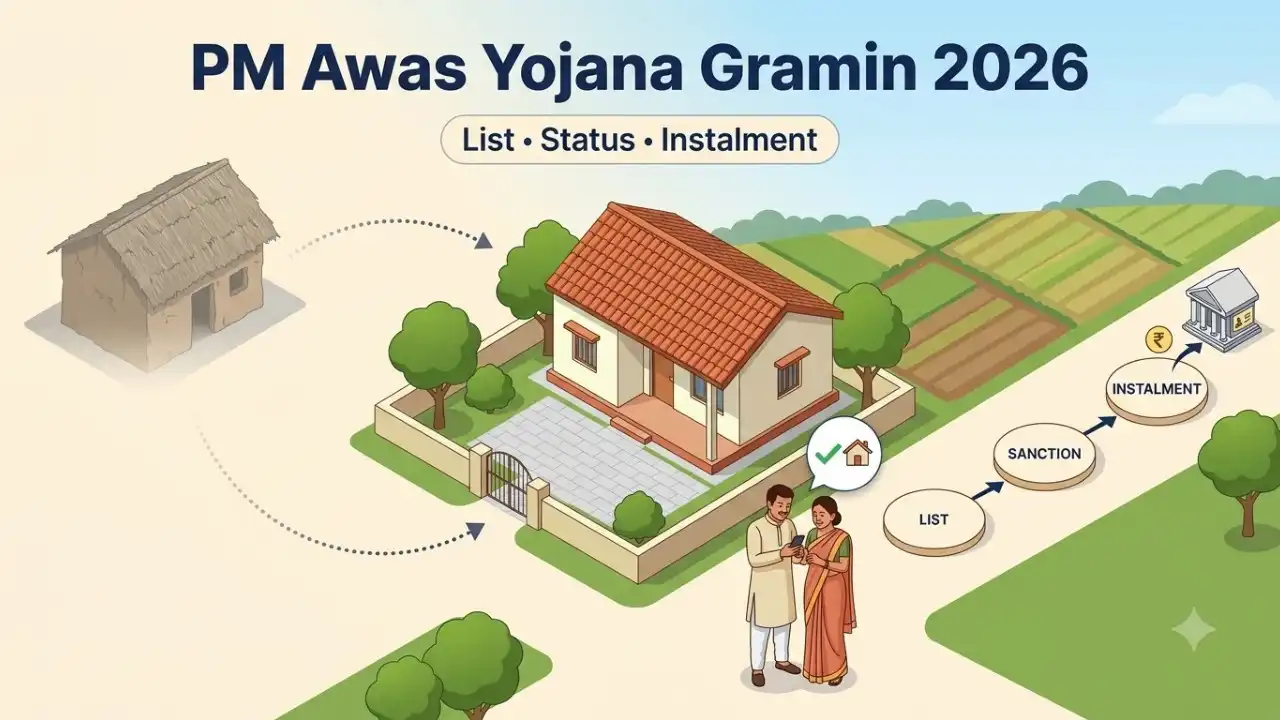
Pradhan Mantri Awaas Yojana–Gramin (PMAY-G) remains one of the largest rural housing programmes in India. The scheme provides financial assistance to eligible rural households that are houseless or live in kutcha or inadequate houses, with the objective of helping them construct a pucca home with basic amenities.
The programme is now being implemented with an overall target of 4.95 crore rural houses by March 2029. As of 3 August 2026, 4.18 crore houses had been allocated to States and Union Territories, around 3.91 crore houses had been sanctioned and 3.12 crore had been completed. Around 79 lakh sanctioned houses were reported to be under construction.
For families looking for their PMAY-G beneficiary list, payment status, eligibility, instalment details or sanction status, it is important to understand that appearing in a survey does not automatically mean that a house has been sanctioned. Beneficiary identification, verification, sanction and payment are separate stages.
Table of Contents
PM Awas Yojana Gramin 2026 Details
| Particular | Details |
|---|---|
| Scheme | Pradhan Mantri Awaas Yojana–Gramin (PMAY-G) |
| Implementing Ministry | Ministry of Rural Development |
| Current overall target | 4.95 crore houses by 2029 |
| Additional target for 2024-29 | 2 crore houses |
| Assistance – plain areas | ₹1.20 lakh |
| Assistance – specified hill/NE areas | ₹1.30 lakh |
| Toilet support | ₹12,000 through scheme convergence |
| Minimum house size | 25 sq. metres, including hygienic cooking space |
| Payment | Directly to beneficiary through electronic transfer |
| Beneficiary identification | SECC/Awaas+ data, prescribed eligibility criteria and verification |
| Current phase | FY 2024-25 to FY 2028-29 |
The Union Cabinet approved an additional 2 crore houses for FY 2024-25 to 2028-29, with a total approved outlay of ₹3,06,137 crore for this five-year period.
How Much Money Is Available Under PMAY-G?
The basic housing assistance continues at:
- ₹1.20 lakh in plain areas.
- ₹1.30 lakh in North-Eastern States and specified hill areas, including Jammu & Kashmir and Ladakh.
- ₹12,000 can additionally be provided for toilet construction through convergence with Swachh Bharat Mission-Gramin or another eligible funding source.
- Beneficiaries can also receive prescribed unskilled wage employment support through convergence with the rural employment programme.

This means PMAY-G support should not be understood simply as a one-time ₹1.20 lakh or ₹1.30 lakh payment. Housing assistance is linked with construction progress and can be supplemented by benefits available through converging government schemes.
PMAY-G Beneficiary List 2026: How Selection Works
A common misunderstanding is that anyone meeting basic income conditions can simply submit an application and immediately enter the PMAY-G beneficiary list.
PMAY-G follows a beneficiary-identification process. Existing selection has relied on housing-deprivation parameters using SECC 2011, Awaas+ data, Gram Sabha verification and an appellate process. For the expanded 2024-29 phase, the government approved updating the Awaas+ list using modified exclusion criteria.
The Awaas+ 2024 system also introduced technology-assisted surveys, including Aadhaar-based face authentication and options for self/assisted survey.
Therefore, three things should not be treated as identical:
Surveyed household → Eligible/verified household → Sanctioned PMAY-G beneficiary
A family recorded during a survey may still have to undergo verification before receiving sanction.
Who Is Eligible for PM Awas Yojana Gramin?
The scheme primarily targets rural households that are houseless or live in zero, one or two-room kutcha houses, subject to the applicable deprivation and exclusion criteria.
The official PMAY-G eligibility questionnaire currently checks factors including whether the household owns a pucca house, has more than two rooms, owns specified motorised vehicles/agricultural equipment, has a government employee, pays income/professional tax, has income above the prescribed threshold, or owns agricultural land above specified limits.
Importantly, final inclusion should not be assumed solely from an online eligibility check. Verification and the applicable beneficiary-selection process remain important.
How to Check PMAY-G Beneficiary Status Online
Beneficiaries can use the official PMAY-G system to check information associated with their housing sanction and implementation.
The most useful details to keep ready are the PMAY-G registration/beneficiary number and basic location information such as State, district, block and Gram Panchayat.
Depending on the report or beneficiary facility being used, users may be able to view information relating to sanction, construction progress and instalments. The government’s AwaasSoft system is used to monitor registrations, sanctions, house completion, instalment releases and other implementation indicators.
The official PMAY-G dashboard also provides broader construction, beneficiary, finance and Permanent Wait List reporting.
PMAY-G Instalment: When Is the Money Released?
PMAY-G housing assistance is not necessarily paid as one lump sum.
Under the implementation framework, States determine the instalment structure subject to scheme requirements. The assistance is released in stages linked with construction progress. Official evaluation material notes a minimum of three instalments, while subsequent instalments may be linked with stages such as foundation/plinth and lintel/roof level.
This is an important distinction because the exact instalment amount can differ by State and payment structure. Beneficiaries should therefore not assume that every State follows an identical ₹40,000 + ₹40,000 + ₹40,000 schedule.
For example, an audit of implementation in Uttar Pradesh documented a State structure of ₹40,000, ₹70,000 and ₹10,000 for ₹1.20 lakh assistance.
Why Can a PMAY-G Instalment Be Delayed?
If a house has been sanctioned but the next payment has not arrived, it does not automatically mean that the beneficiary has been removed.
Payments are connected with the construction and monitoring process. Delays can arise from issues involving construction-stage updates, fund availability or release, MIS/PFMS processing and other implementation requirements. Government reporting has also identified delays in State/Central share movement and implementation issues among the challenges affecting the scheme.
Beneficiaries facing a prolonged delay should first verify the construction stage recorded in the system and payment status, and then approach the concerned Gram Panchayat, Block or rural development authority where necessary.
What Does Sanctioned Status Mean?
A sanctioned house is more significant than merely appearing in a survey or potential beneficiary database. Sanction indicates that the household has moved into the approved housing process.
After sanction, payment and construction progress are monitored digitally. Geo-tagging and other technology-based monitoring mechanisms are used under the programme.
As of 3 August 2026, the government reported approximately:
| PMAY-G Progress | National Figure |
|---|---|
| Target allocated to States/UTs | 4.18 crore |
| Houses sanctioned | 3.91 crore |
| Houses completed | 3.12 crore |
| Sanctioned houses under construction | 79 lakh |
These figures show why a household may be sanctioned but not yet have a completed house.
What If Your Name Is Not in the PMAY-G List?
Not finding a name in a particular beneficiary report should not immediately be interpreted as permanent rejection.
The government approved updating the Awaas+ list specifically to identify additional eligible rural households for the expanded 2024-29 programme. The Awaas+ 2024 survey uses revised criteria and digital verification tools.
A household should therefore check whether it has been surveyed, whether verification is pending and whether it meets the current eligibility conditions. Local Gram Panchayat or Block-level rural development officials can be relevant where online information does not explain the status.
PMAY-G Is Different From PMAY-Urban
Applicants should also avoid confusing PMAY-G with PMAY-U.
PMAY-G is intended for eligible rural households, whereas the urban housing programme operates separately. A person looking for a rural beneficiary list or rural housing sanction should use PMAY-G facilities rather than PMAY-Urban portals.
Frequently Asked Questions
How much money is given under PMAY-G in 2026?
The unit assistance is ₹1.20 lakh in plain areas and ₹1.30 lakh in specified North-Eastern and hill areas. Eligible beneficiaries can also receive ₹12,000 for toilet construction through convergence and prescribed wage support.
Can I check the PMAY-G beneficiary list online?
Yes. PMAY-G/AwaasSoft provides beneficiary and scheme reports through its official online system. Availability and the search method can vary depending on the particular report being accessed.
Does appearing in Awaas+ guarantee a PMAY-G house?
No. Survey inclusion should not be treated as final sanction. Eligibility and beneficiary verification are required before sanction.
Is PMAY-G money released in one payment?
Generally, no. Housing assistance is released in instalments linked with construction stages. The exact instalment structure can vary by State.
What is the PMAY-G target?
The overall programme target is 4.95 crore houses by 2029, including 2 crore additional houses approved for FY 2024-25 to FY 2028-29.