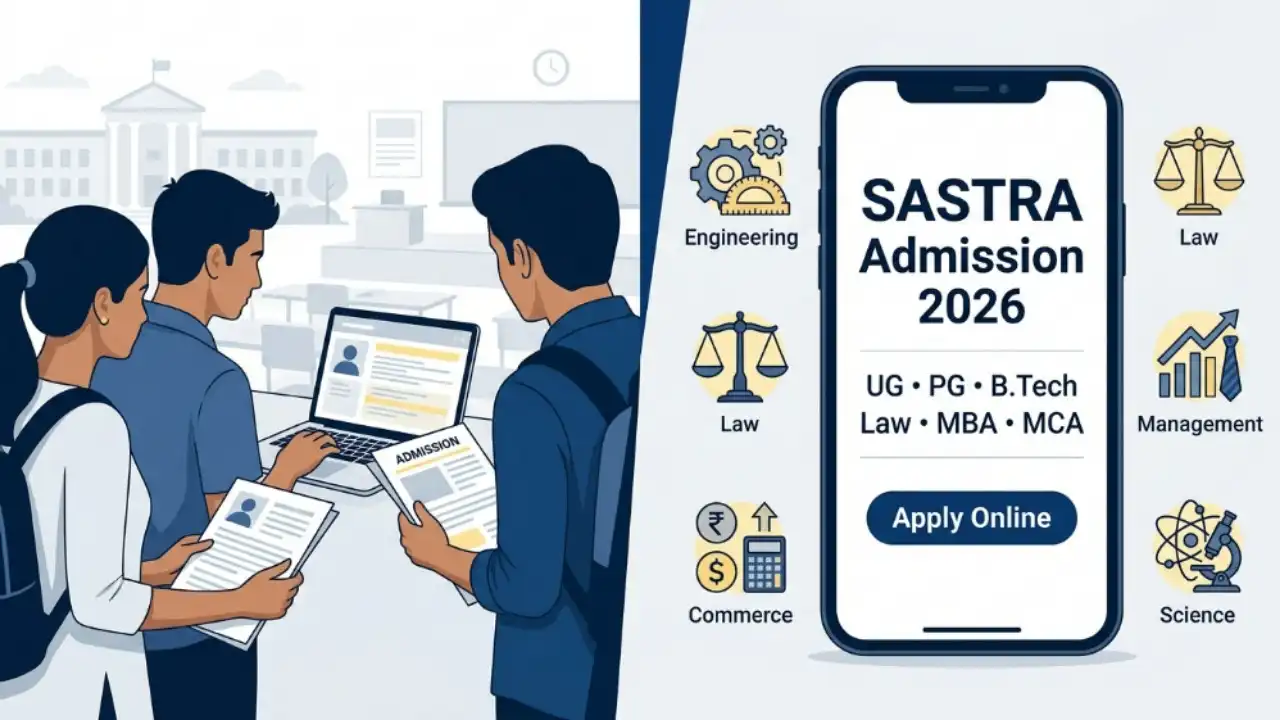
SASTRA Deemed University has opened the application process for Admissions 2026 across multiple undergraduate, postgraduate, integrated, law, management, computer application, science, commerce, education and research-linked programmes. Candidates can apply through the university’s online admission system, where new applicants must register, create an applicant ID, enter academic details and complete the form submission process.
The admission update is not limited to B.Tech. While engineering remains one of the most searched courses, SASTRA’s 2026 admission cycle covers a much wider academic basket, including B.Tech, 5-Year Integrated M.Tech, M.Tech, M.Sc, MBA, MCA, B.Com, BBA, BCA, B.A. Economics & Public Policy, integrated law programmes, education courses and other UG/PG programmes. The official FAQ also confirms that admissions are being conducted online and that applications for different campuses must be submitted separately, where required.

The important date for several high-demand programmes is June 5, 2026. For B.Tech and 5-Year Integrated M.Tech, the application window started on March 27, 2026, and the last date is listed as June 5, 2026. Law Phase II applications also run till June 5, 2026, while MBA, MCA and several other UG/PG programmes are being handled through rolling admissions in batches.
Table of Contents
SASTRA Admission 2026 Latest Update
SASTRA has activated the online admission process for the 2026 academic session. Candidates can register through the admission portal and choose the relevant campus and programme before submitting their academic details.
The university’s admission structure is programme-specific. Engineering admissions use a two-stream system, law admissions are linked with CLAT and Class 12 scores, MBA admissions consider degree scores, entrance test and interview, while MCA admissions are based on qualifying degree scores and a SASTRA-conducted entrance test. Other UG and PG courses are largely based on qualifying examination marks and CUET 2026, if CUET results are available on time.
This makes the current application form important for a broader group of students, not only engineering aspirants. Candidates looking for commerce, management, computer applications, law, sciences, education, economics and postgraduate programmes should also check the admission schedule and complete the form as per their course category.
Courses Covered Under SASTRA Admissions 2026
SASTRA’s 2026 admission notice and FAQ mention programmes across its Thanjavur, Kumbakonam and Chennai campuses. The course availability depends on the campus selected by the candidate.
| Course Category | Programmes Mentioned for Admission 2026 | Admission Basis |
|---|---|---|
| Engineering | B.Tech with various specialisations, 5-Year Integrated M.Tech | JEE Main 2026 + Class 12 marks / Class 12 marks |
| Postgraduate Engineering | M.Tech | Qualifying degree marks: GATE candidates get preference/benefits |
| Law | B.A. LL.B. Hons, B.B.A. LL.B. Hons, B.Com. LL.B. Hons | CLAT 2026 and/or Class 12 marks |
| Management | MBA | Degree score, entrance test and interview; preference for CAT/XAT/AIMAT/CMAT/AIMCAT |
| Computer Applications | MCA | Qualifying degree score and SASTRA entrance test |
| Science | M.Sc programmes including Biotechnology, Bioinformatics, Chemistry, Data Science, Electronics and Physics; other science courses | Qualifying marks / CUET, where applicable |
| Commerce and Business | B.Com, B.Com CA, B.Com BFSI, BBA, M.Com | Class 12 or qualifying degree marks |
| Arts and Policy | B.A. Economics & Public Policy | Class 12 marks |
| Education | B.Com B.Ed, B.Sc B.Ed Sciences | Class 12 / qualifying marks |
| Other UG/PG Courses | Programmes in Sciences, Arts, Commerce and related fields | Qualifying marks and CUET 2026 |
Campus-Wise Course Availability
At the Thanjavur campus, SASTRA lists several major programmes, including B.Tech with minor specialisations, 5-Year Integrated M.Tech, M.Tech, M.Sc, MCA, MBA, B.Com, integrated law programmes, B.Com B.Ed, B.Sc B.Ed and other science-linked programmes.
At the Kumbakonam campus, the university has listed B.Sc, B.Com, BBA, BCA, M.Sc in Computer Science, Mathematics and Biochemistry, M.Com, and B.Tech courses in CSE and ECE.
At the Chennai campus, SASTRA has listed B.Com, BBA, BCA, B.A. Economics & Public Policy, MBA and M.Sc Data Science. The Chennai campus also includes regular three-year programmes and a 2+1 year mode with industry partners under AEDP mode for selected programmes.
B.Tech and 5-Year Integrated M.Tech Admission 2026
For B.Tech and 5-Year Integrated M.Tech, SASTRA will follow a two-stream admission model. Under Stream 1, 50% of seats will be filled using JEE Main 2026 scores and normalised Class 12 scores, with 50% weightage each.
Under Stream 2, the remaining 50% of seats will be filled based on Class 12 scores alone. This is an important point for students who did not appear for JEE Main because SASTRA has clearly stated that JEE is not mandatory for engineering admission.
The university has also mentioned that all students will be considered for both streams by default. If a student has not written JEE Main, the student will still be considered under the Class 12 marks-based stream.
B.Tech Specialisations Listed by SASTRA
SASTRA has listed a wide range of B.Tech programmes for the 2026 cycle. These include Aerospace Engineering, Bioengineering, Bioinformatics, Biotechnology, Chemical Engineering, Civil Engineering, Computer Science & Engineering, CSE with Artificial Intelligence & Data Science, CSE with Cyber Security & Blockchain Technology, CSE with IoT & Automation, CSE with Networks, Electrical and Electronics Engineering, Electronics & Communication Engineering, Electronics and Computer Engineering, Electronics & Instrumentation Engineering, Robotics & Artificial Intelligence, Electronics Engineering with VLSI Design & Technology, Information Technology, Industrial Engineering and Management, Mechanical Engineering and Mechatronics.
The university also offers minor specialisation options such as Artificial Intelligence & Machine Learning, Robotics & Automation, Cyber Security & IoT, Quantum Computing & Quantum Technologies, Nanotechnology, Sustainability Engineering, Public Policy & Management, Nuclear Technologies, Programming & Applications Development and Innovation & Entrepreneurship.
This course spread is important from an admission perspective because students are not applying for a single engineering branch. They are entering a merit-based process where campus, stream, branch preference and rank may all influence final allotment.
Law Admission 2026
SASTRA’s 5-Year Integrated Law programmes include B.A. LL.B. Hons, B.B.A. LL.B. Hons and B.Com. LL.B. Hons. Admission is being conducted in two phases.
Phase I was based on CLAT 2026 scores, with the application period listed from March 27 to April 19, 2026. Phase II is based on Class 12 scores plus CLAT 2026 scores, with applications open from March 27 to June 5, 2026.
For Phase II law admissions, the combined merit score gives 50% weightage to CLAT 2026 and 50% weightage to Class 12 board marks. If a student has not written CLAT, the CLAT component will be treated as zero while computing the combined score.
MBA, MCA, M.Tech and M.Sc Admissions
SASTRA MBA admission is based on qualifying degree scores, entrance exam and interview. Candidates with good scores in CAT, XAT, AIMAT, CMAT or AIMCAT will be given preference. Admissions are being conducted on a rolling basis in multiple phases.
For MCA, admission will be based on qualifying degree scores and an entrance exam conducted by SASTRA. This is also being handled through rolling admissions in batches.
For M.Tech and M.Sc programmes, admission will be based on the scores obtained in the qualifying UG or PG degree programme. SASTRA has also mentioned that GATE-qualified candidates will receive benefits such as tuition fee waiver and stipend, as per the university’s admission FAQ.
Other UG and PG Programmes
For other undergraduate and postgraduate programmes in sciences, arts, commerce, education and related disciplines, admissions will be based on qualifying examination marks and CUET 2026 if CUET results are available on time.
This category is important for students applying for B.Com, BBA, BCA, B.A. Economics & Public Policy, B.Sc-linked programmes, M.Com and similar courses. The admission process for these courses may not follow the same fixed deadline pattern as B.Tech and law, as many are listed under rolling admissions in batches.
Candidates should therefore not assume that every course closes on the same date. They should check the programme-specific status while applying and complete the form early to avoid batch-wise seat availability issues.
Eligibility Criteria: Candidates Should Check
For B.Tech and 5-Year Integrated M.Tech, SASTRA requires 60% aggregate in Class 12 with Mathematics and Physics as compulsory subjects, along with Chemistry, Biotechnology, Computer Science or Biology as the third subject, depending on the programme. For some biotechnology, bioinformatics, bioengineering and integrated technology programmes, applicants without Mathematics may also be eligible under specific conditions.
For law programmes, candidates need to pass Class 12 in the academic stream in the first attempt with at least 60% aggregate and English as a subject of study.
For MBA, candidates need a first-class recognised bachelor’s degree of minimum three years. For MCA, candidates need a recognised bachelor’s degree of minimum three years with Mathematics as a subject either in Class 12 or in the qualifying degree course.
SASTRA has also listed an age condition for undergraduate applicants. UG applicants should not have completed 19 years as on August 1, 2026. For lateral entry programmes, applicants should not have completed 21 years as on August 1, 2026.
Data Points That Make This Admission Cycle Important
The first major data point is the 50:50 engineering admission model. Half of the B.Tech and 5-Year Integrated M.Tech seats are based on JEE Main plus Class 12 scores, while the other half are based on Class 12 scores alone.
The second important figure is the 60% minimum aggregate rule for several major programmes, including B.Tech and law. This makes board performance central to the admission process, even where entrance test scores are considered.
The third important factor is the regional allotment structure for engineering admissions. SASTRA has mentioned that the allotment pattern includes students from Thanjavur and Trichy, Tamil Nadu and All India categories, with special provisions for North East and special status States/UTs. This means admission is not only about marks but also about the allotment framework notified by the university.
Why Candidates Should Not Treat This as Only an Engineering Form
The biggest confusion around SASTRA admissions is that students often search mainly for B.Tech admission. However, the university’s current admission cycle includes several non-engineering programmes across commerce, law, science, management, computer applications, arts, economics and education.
This matters because a student looking for B.Com, BBA, BCA, MBA, MCA, M.Sc or law admission may miss the form if the update is presented only as “B.Tech admission”. The correct framing is that SASTRA Admissions 2026 are open for multiple courses, with B.Tech being only one major part of the cycle.
From an editorial point of view, candidates should first identify the campus and course, then check the admission basis. Engineering, law, MBA, MCA and other UG/PG programmes follow different selection rules, so one admission formula does not apply to all programmes.
How to Apply for SASTRA University Admission 2026
Candidates need to visit the SASTRA online admission portal and register as a new applicant. During registration, they must enter their name as per certificate, date of birth, mobile number, email ID and category details.
After registration, candidates should select the campus and programme carefully. SASTRA has stated that applications must be submitted separately for each campus, so students applying across campuses should not assume that one campus application will automatically cover another.
After filling academic details, entrance score details where applicable and programme preferences, candidates should verify the information and complete the fee payment. The submitted application and payment confirmation should be saved for future reference.