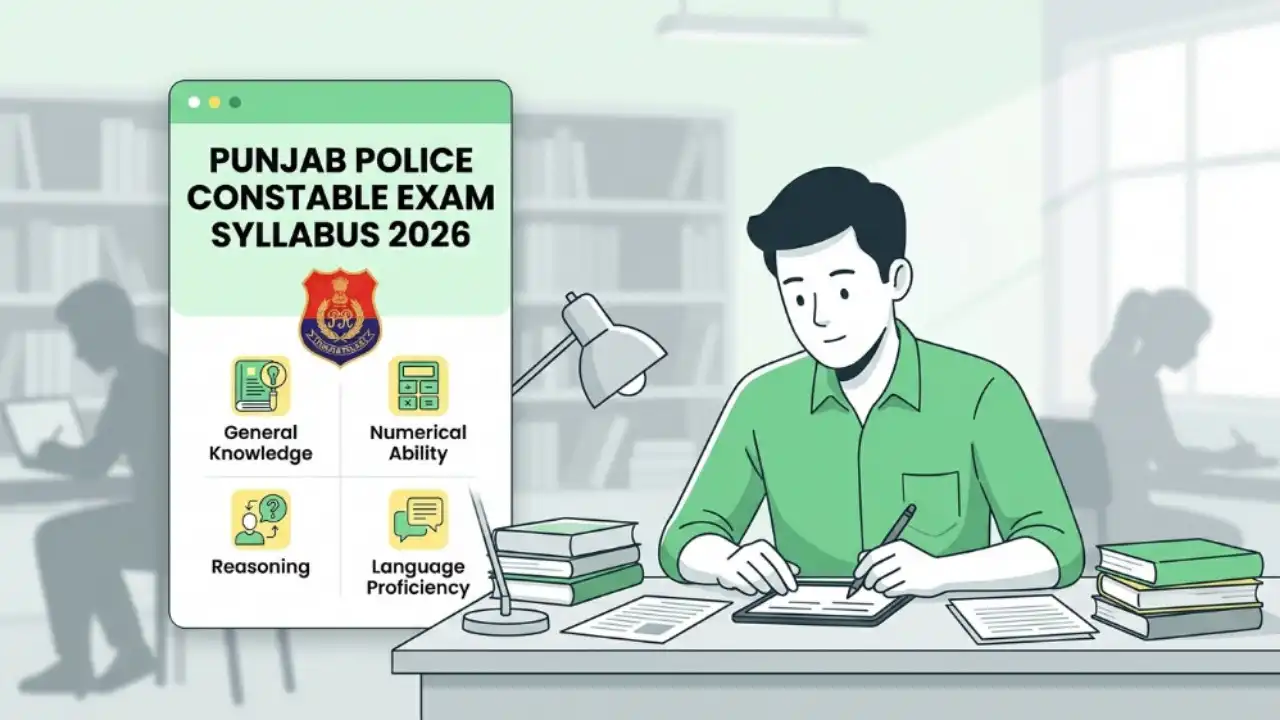
With the Punjab Police Constable Recruitment Examination now approaching, thousands of candidates across the state have shifted their focus from application-related updates to final-stage preparation. The Computer-Based Test (CBT), which is scheduled to begin from July 1, has become the primary concern for aspirants seeking a position in one of Punjab’s largest ongoing police recruitment drives.
The recruitment campaign has attracted significant attention due to the large number of vacancies announced for Constable posts in both the District Police Cadre and the Armed Police Cadre. As examination dates draw closer, search interest surrounding the Punjab Police syllabus, exam pattern, important topics, and preparation strategy has increased considerably.

For many candidates, particularly first-time applicants, understanding the structure of the examination may prove just as important as studying individual subjects. Previous recruitment cycles have shown that a large number of aspirants struggle not because of a lack of knowledge, but because they underestimate the importance of certain sections or fail to allocate preparation time effectively.
Table of Contents
Punjab Police Constable Exam 2026 Highlights
| Particulars | Details |
|---|---|
| Recruitment Authority | Punjab Police |
| Post Name | Constable |
| Examination Mode | Computer-Based Test (CBT) |
| Exam Commencement | July 1, 2026 |
| Total Questions | 100 |
| Total Marks | 100 |
| Duration | 2 Hours |
| Negative Marking | No |
| Qualifying Punjabi Paper | Yes |
| Selection Process | CBT, PMT, PST, Document Verification |
The absence of negative marking is often considered one of the biggest advantages for candidates. It allows aspirants to attempt all questions without the fear of losing marks due to incorrect responses.
Why the Written Examination Matters More Than Many Candidates Realise
Among police recruitment aspirants, there is often a tendency to focus heavily on physical preparation. While physical fitness is undoubtedly important, recruitment trends suggest that the written examination remains the stage where the largest number of candidates are filtered out.

The CBT is designed to assess not only academic knowledge but also logical thinking, language proficiency, awareness of current events, and basic digital literacy. A balanced performance across all sections generally produces better results than excelling in only one or two subjects.
Candidates who begin preparation by understanding the examination structure often gain an advantage over those who rely solely on coaching notes or last-minute revision materials.
Understanding the Punjab Police Exam Pattern
The Punjab Police written examination consists of multiple sections covering different competencies expected from a police constable.
Paper I (Merit-Based Examination)
| Subject | Questions | Marks |
|---|---|---|
| General Awareness | 35 | 35 |
| Quantitative Aptitude & Numerical Skills | 20 | 20 |
| Mental Ability & Logical Reasoning | 20 | 20 |
| English Language Skills | 10 | 10 |
| Punjabi Language Skills | 10 | 10 |
| Digital Literacy & Computer Awareness | 5 | 5 |
| Total | 100 | 100 |

Duration: 120 Minutes
A close examination of the pattern reveals that General Awareness carries the highest weightage. This means candidates who maintain strong current affairs preparation and possess a good understanding of Punjab-related topics may secure a valuable scoring advantage.
Punjabi Language Paper
Apart from the main examination, candidates are also required to qualify a Punjabi language paper conducted at the matriculation standard.
Although its marks are not counted for merit preparation, failure to qualify this paper can affect eligibility for later stages of recruitment.
As a result, candidates should avoid treating the Punjabi paper as a formality.
General Awareness Likely to Remain the Most Important Section
The General Awareness section alone contributes more than one-third of the total marks available in the examination.
Topics generally include:
- Punjab History
- Indian History
- Indian Constitution
- Geography
- Current Affairs
- Economy
- Government Schemes
- Science and Technology
- Sports
- National and International Developments
Experts frequently advise candidates to pay special attention to Punjab-specific current affairs. Questions related to state government initiatives, historical events, prominent personalities, and administrative developments often appear in police recruitment examinations.
Candidates who focus only on national current affairs may miss opportunities to score easy marks in this section.
Reasoning and Mental Ability Can Create a Difference
The Reasoning section is often viewed as a scoring area because many questions are based on patterns and logical thinking rather than factual memorisation.
Common topics include:
- Coding-Decoding
- Blood Relations
- Direction Sense
- Analogy
- Series
- Classification
- Seating Arrangements
- Puzzle-Based Questions
- Syllogism
Regular practice generally plays a more important role than theoretical study in this section. Candidates who solve reasoning questions daily often develop the speed required to perform effectively during the actual examination.
Quantitative Aptitude Remains a Challenge for Many Aspirants
The Numerical Ability section continues to be one of the areas where candidates lose valuable marks.
Key topics include:
- Percentage
- Ratio and Proportion
- Average
- Profit and Loss
- Time and Work
- Time and Distance
- Simple Interest
- Compound Interest
- Number System
- Data Interpretation
Rather than attempting advanced mathematics, candidates should focus on strengthening basic concepts and improving calculation speed.
Language Sections Should Not Be Ignored
Both English and Punjabi language sections contribute to the overall score.
Questions are generally based on:
- Grammar
- Vocabulary
- Synonyms and Antonyms
- Error Detection
- Sentence Improvement
- Reading Comprehension
Language sections often provide relatively straightforward marks to candidates who revise grammar fundamentals regularly.
Digital Literacy Offers Easy Scoring Opportunities
Despite carrying only five marks, Digital Literacy remains one of the most overlooked sections.
Questions may be asked from:
- Computer Fundamentals
- Internet Usage
- MS Office
- Cyber Security Basics
- Operating Systems
- Digital Services
Many successful candidates from previous recruitment cycles have emphasised that computer awareness can become a quick source of marks with comparatively little preparation time.
Physical Tests Will Follow the Written Examination
Candidates who clear the written examination will proceed to the physical evaluation stages.
These stages generally include:
Physical Measurement Test (PMT)
The PMT verifies height and other prescribed physical standards according to recruitment rules.
Physical Screening Test (PST)
The PST evaluates physical endurance through activities such as running and jumping events.
Unlike the written examination, physical tests are qualifying in nature. Candidates simply need to meet the prescribed standards to remain eligible.
What Should Candidates Focus on During the Final Weeks?
As the examination date approaches, preparation strategies often become more important than studying new topics.
Aspirants may benefit from:
- Daily revision of Punjab current affairs
- Full-length mock tests
- Previous-year paper analysis
- Revision of Punjabi grammar
- Computer awareness practice
- Speed improvement in reasoning and aptitude
Experts generally recommend avoiding excessive dependence on new study materials during the final weeks. Consolidating existing preparation often produces better results than constantly changing resources.